This is a very good and very entertaining reading! I watched many times creating the video, and am still not bored! He's good, that Brandon man.
Brandon Pitts at his book launch for 'Puzzle of Murders,' published by Bookland Press, at the Toronto Public Library on November 6, 2011. Brandon was introduced by the publisher, Robert Morgan. http://brandonpitts.com
A video by Brenda Clews.
Notes on the video:
Editing this video, I came to enjoy the intermittent gritty, shaky, out-of-focus quality of the clip, and did not remove it; it provides texture to the reading. It helps to impart the sense of Geist (mind, spirit, or ghost), of the author, of the insane logic of the central character of Puzzle of Murders, of the murder mystery itself. It is as if ghosts and blood and memory swirl about. There is a bodily sense of the videographer in the fuzzy hand-held quality also, another Geist. That is the eye of the videographer, and it transmits a moving image to the audience viewing the scene. It is the eye of the world watching, or perhaps its ghosts. The view is not smooth, featureless, glossy, but cinematically uneven, rough. These imperfections in the video normally would be removed in editing. I resisted, then became accustomed to them, then began to understand that where the picture has a gritty motion is where the ocean of words seeps into the vessel of the reading from the novel. That's where the salt water enters with its briny catch of krill and seaweed and skeletal remains. The imperfections give texture to what is charming, beautiful. Beauty cannot approach us in its wholeness without its flaws, deformities, fragmentations. Slice-of-life, it's messy on the edges, it has its own reality. The book is full of slips and fissures, so is the video of the launch. I hope you enjoy what I have created from my video of the event.
I finished this video on Brandon's birthday, December 28th, 2011, a perfect birthday present for him.
The background clips are free stock footage from Vimeo: black ink; woman.
...dear beautiful people in my life... you all mean so much to me, you
cannot know.
...this year I thought I had nothing to share (art or poem or video),
but, then, Shadow Cave is about reaching into the darkness in
ourselves and bringing what is hidden in us to light, which is sort of
like the return of the sun in the darkest moment.
It's a small offering, and perhaps too long to watch. Don't worry if
you don't, I don't mind and I'll still love you. I did subtitle it, so
click on the cc if you'd like to read along, or translate into another
language.
It's based on a real ritual I did in 1995 and wrote an extensive entry
in my journal about. I re-wrote the ritual as a sort of modern fairy
tale. It's about integrating ourselves at our deepest levels, however
we image that. Sometimes what is in our shadows is not anything
'sinful' at all! It's only what we've repressed in ourselves... which
could be our recognizing how luminescent we really are!
Shadows and dopple gangers appear in this videopoem, as ever. :)
Please forgive. (I just can't help being multiple, ya know!)
I offer it to the light within us.
On this Solstice, Festival of the Lights, and for the auspicious
coming year, many blessings to you, wishes for good health,
prosperity, good fortune in work, relationships, family, and the
success of all your creative endeavours,
I highly recommend this little app for .99cents, if you have an iPhone (3 or 4), an iPod touch, or an iPad (1 or 2). You load the app, set the alarm, and put it on the mattress next to you face down without turning your device off. It maps your sleep cycles all night. In the morning it generates a lovely little graph for you. It is one of the best selling apps in the world, and it is not hard to see why.
Not only that, but it is an alarm clock that will gently wake you when you are in your lightest sleep phase in the half hour time period you set for the alarm.
You can learn a a lot about your sleep habits, and perhaps how to improve them so that you wake feeling refreshed, and ready for the day.
I've only used it twice, and have included my graphs too, at the end of this article.
Have you ever woken up feeling completely wrecked when the alarm clock goes off, despite the fact that you have slept "enough" hours? When this happens you have probably been awakened during a deep sleep phase, and your whole day can turn into one long zombie marathon.
Other days you spring out of bed with a smile on your face, feeling completely rested even though you shouldn't. As the alarm clock goes off, chance seems to play a big role in how your day will become. But does it really have to be that way? This is where the Sleep Cycle alarm clock application comes into play.
During the night you go from light sleep to deep sleep, occasionally entering into a dream state which is called REM-sleep. These are things that your normal alarm clock does not care about, and will go off at the set time regardless of whether you are in a light sleep phase or in the deepest sleep. However, since you move differently in bed during the different phases, the Sleep Cycle alarm clock is able to use the accelerometer in your iPhone to monitor your movement and determine which sleep phase you are in. Sleep Cycle then uses a 30 minute alarm window that ends at your set alarm time and wakes you in your lightest sleep phase.
"This isn't really something new. These so called bio-alarm clocks have been around for years and work very well, but they usually come with a hefty $200 price tag. I realized that the iPhone has all the components needed, and decided to make an alarm clock that works exactly the same, but sell it for a dollar or two instead."Maciek Drejak, the programmer behind the application, says.
Example 1: a typical sleep graph
Example 2: more irregular sleep with a period
of being awake or nearly awake at 6am
The second example has a bit more irregular sleep. The user did probably not sleep as well as in example 1. In this example the user's partner got up at 6am. This is clearly seen - the user was awake or nearly awake at around 6am when her or his partner got up.
My graphs from two recent nights.
I was blown away because that day I did, indeed, wake at 7am, but as I didn't need to get up, drifted back off for awhile. My sleep hit some deeper phases but nothing like the "normal sleep graph."
Happy to see at least one dip into "Deep Sleep." This sleep was after 3 churning, sleepless nights, and I was exhausted, and, for me, slept very well.
Yay! HP has finally provided an OS X Lion driver for my printer scanner! I re-worked one of the ink drawings/paintings in my Moleskine sketchbook tonight.
"LANGUAGE IS THE CAGE THROUGH WHICH I EXPRESS MY PASSION" - detail - 21cm x 29cm, 8" x 11.5", 2011, India and acrylic ink, gel pen, oil paint on Moleskine Folio Sketchbook A4 prepared with a base of acrylic matte medium. Prints available too!
Below the first draft, and the second. I think it's finished, but... could give better definition to her arms and hands, make the line a little more lyrical; on the other hand, she is marionette-like. She is meant to impart a feeling of contained, and what easier way to convey that imprisonedness, in language, in form than with hands and feet that are as if sewn? The feet are hanging almost, puppet-like, and the hands as if sewn into the lines of the painting - yet there is a regal quality to her, I think of her as a doll who has echoes of a Spanish dancer, proud, beautiful. Her head, neck and torso have an inner frame, perhaps wood, over which the costume is affixed; the arms and legs are stuffed cloth. The way such dolls are. She wears a corset and only half of a skirt of black lace. Despite the contraints, she dances in the painting, the passion broiling in the red, firing her.
A man who calls himself Papytroll Michel (on Facebook) wrote: "Merveilleuse ta ballerine ensanglantée au visage dépecé.Très puissant.Très bon partage clair/obscur. Encore, encore d'autres :) Supernatural your ballerina stained with blood with the dismembered face. Very powerful. Very good clear / dark division(sharing). Still, still the others:)"
I thanked him for his insightful comment that is like poetry, and '...I don't know where these paintings come from, even I have to try to understand them, and your comments help me to see deeper in their meanings... rarely do I set out to draw or paint something specific... rather... to discover what is there.'
Ruah Edelstein's films exude an innocence and a child-like joy. Her animation is among my favourite. When I need to find blessing, I return to Ruah's films.
For the Solstice/Hanukkah/Christmas festive season, I present one of her Oah and Harlam Episodes: Of Stars and People.
In Of Stars and People, we find Oah falling through the skies downwards. Snow falls as Oah falls, turning in the sky. A male voice (Dylan Forman) narrates for Oah, and a female voice (Ruah herself) for Harlam. When Harlam appears, he seems to emerge from the landscape itself, and he is but a shadow over it. His eyes are deep, and compassionate. He turns, and we watch a white gull glide in the distance while the female narrator tells us Harlam 'was laughing.' Different levels of the landscape move differently in the animation. An outer sky seems to come with us as we draw back from the wide angle view of the scenic ocean with its mountains in the distance. 'Harlam was laughing at Oah. ' Then Oah is rising from a field of green with round white circles all about, rubbing herself off, having landed. Dandelion fluff billows a little like the snow we saw earlier. She is in a field of dandelions. 'But when a star falls, one must make a wish.' Oah blows a dandelion seed head, and "Made a wish for Harlam, instead.' The dandelion seeds fly out like little white trees, or snowflakes, or stars. 'Oah made a kind wish.' Both narrators speak the same words. Harlam is making a kind wish too. It is a giving message, and I love it. Yoon Lee's music is perfect (he plays the guitar, kalimba and kayagum; with Molly McLaughlin on flute; and Kassandra Kocoshis on percussion), and if you browse Ruah's blog, you'll find more on his work, as well as a film, Summary, that they collaborated on. (A photo of Yoon scoring the music for Of Stars and People.)
One more episode to the series! At first glance the stories about two weirdoes Oah and Harlam may appear as senseless. But when there is an overflow of senselessness, then appears deep philosophy.
These stories are not just shorts that I wrote, they are a worldview, answers to some questions of reality, grotesque simplicity of which seems to be surreal. In this project bits of life situations, thoughts, and actions are applied to animation, music, and a spoken word. There is a need to write fairytales for grownups, to write almost impossible stories, because when we seriously begin to talk about important and intimate things in life, most of us cannot take it.
Original music scored by Yoon Lee involves a rare use of instruments such as kalimba and kayagum (Korean zither).
Ruah's work has a deceptive simplicity, not only in the poetry, which is fairytale-like, but in the animation itself.
The figures have a transparency as they move over a background which appears through them. In her blog we learn, "I used oil paints for all the layers in the background, which was very fun to work with, while seeing how the paints interconnect after being layered digitally on screen." Before she reaches the stage of digitalizing, there is the rush of ideas, and storyboarding.
To the right you will see images of her work flow for the film featured today (if you click on the image, you'll go to her blog post). In the first image, simple, raw sketches of ideas as they emerge from her imagination. She writes, "This is one of my most favourite stages, where visuals are coming out for the first time to being without any restrictions, a very intuitive and spontaneous process to allow all sorts of visualizing ideas to come up." She says, be "loose," "minimilist," while "touching only on the keys of the story." Then comes the storyboard, which she keeps nearby her working area "at all times," shows to "friends and colleagues," and "thinks about over and over." She follows it closely when making the film.
Already we are beginning to suspect a master at work here. Browsing Ruah Edelstein's website, we find she is, indeed, an accomplished artist - in fact, the sale of her art enabled her to move from Europe to California where she is currently working on an MFA in animation at the California Institute of the Arts (CalArts). Before being drawn to animation, she was an actress, and also directed. Originally from Lithuania, where she grew up while her country was still part of the USSR, her Bio tells us, that, at age 10 she was accepted in to "a renowned School of Fine Arts in Klaipeda, her hometown at the coast of the Baltic sea." Most recently, she had an Oah and Harlam film in the Chelyabinsk No-Festival of Video Art and Animation in 2010; Of Giants, was selected for the Animex Awards in Feb 2011, held in the UK; and she presented Oah and Harlam episodes in San Diego at a NOW conference for authors and critics of contemporary, innovative literature in Oct 2011. Expect to see this lady's work regularly on the festival circuits when she hits her stride. Her films, with their whimsical, fairytale-like stories and characters, and their deeper philosophies giving a profundity to her work, are outstanding.
_
This is my last article of 2011; FRIDAY VIDPOFILM will return January 6, 2012. Warmest season's greetings to everyone!
My videopoem, Voicings, was featured on L|P|S! I'm delighted! London Poetry Systems writes: "Each month one video makes it onto the Systems homepage." It's here, on Vimeo: http://vimeo.com/33159867. The YouTube upload is embedded below. (It was actually one of the rehearsals ::smiling:: I thought to upload different versions at different sites. ::smiling:: The final version is here.)
vimeo.com
London Poetry Systems is an open cross-media poetry platform. This channel is an archive of cross-media poetry. Check out the featured videos and if you'd like to know more about what we do, and/or contribute in some way, please visit the Systems at: http://www.londonpoetrysystems.com/
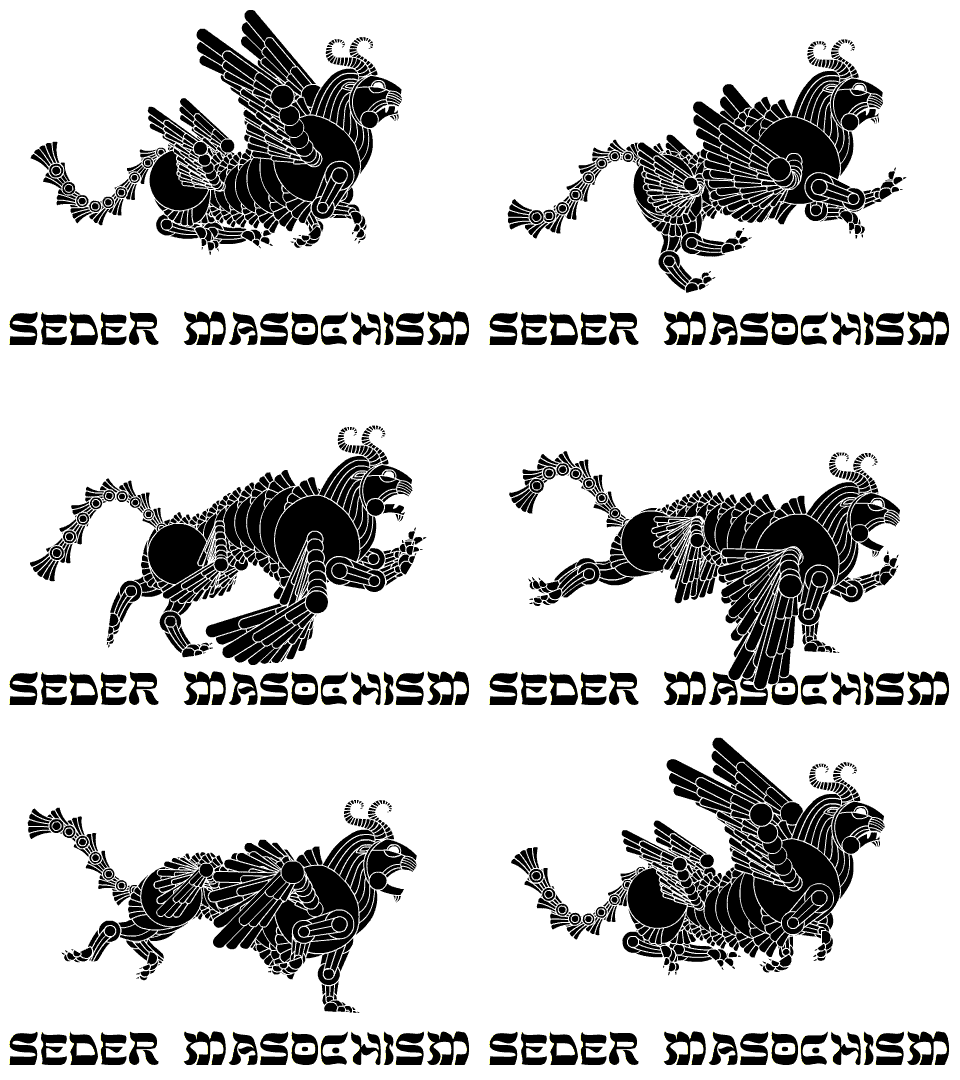
Isn't this gorgeous?! Look at the motion all the way through, and those hind legs! Even the paws return back, with their claws, and not in perfect unison. Wow. Brilliant. Created by Nina Paley.
Nina writes: Some infinities are bigger than others. This Leviathan has a few extra receding loops, making it more infinite than the version I posted earlier.
These older gems have been on YouTube for 5 or 6 years. The first, Sylvia Plath Reads Lady Lazarus, has about a quarter of a million views; the second, Sylvia Plath Reads 'Daddy,' is in the half a million range. In the world of video/film poetry, these two flicks are superstars.
Unfortunately they come to us without any filmmaker information. Who made them? Who is the actress? That information was not recorded, or was cut off, when they were copied from British television at least 20 years ago or longer and later transferred to a format for uploading to YouTube. I was unable to find anything on their origin after an afternoon of looking on-line, but am very glad that these film poems are there for us to see.
Each film uses Sylvia Plath'sown readings of her poems. Her readings are as powerful, intense, and gripping as her confessional poetry. Both were recorded by the BBC shortly after they were written. The power that drove her to write them is, to my ear, in her voice as she reads them. The cauldron of her creativity was still on fire. They are riveting, strong poems on the page, and aurally. I would have liked to see her as she read her poetry that day, but we can only imagine her presence.
Sylvia Plath, as many readers might know, was a talented poet who was married to Ted Hughes and who bore two children with him. After they separated, Plath awoke before dawn each day and wrote her most inspired poetry, collected in the slim volume, Ariel. She committed suicide by turning on the oven after blowing out the pilot light and blocking the drafts under the doors while her children slept. Her death ricocheted her to posthumous fame. She has been an immensely popular and influential poet for almost 50 years.
Her final poetry arises out of a world that is still dealing with the massive and inhumane deaths during the war. Coming to grips with the Holocaust, for instance, a painful and sensitive issue, was especially acute in the post-war period. Plath's father was German, and she not only felt abandoned at 8 years of age when he died, but he became symbolic of the Nazi spirit to the young poet who identified with the Jewish people who were gassed to death in the concentration camps. 'Daddy,' the second film poem below is an indictment not only of Nazi Germany but of the horrors its descendants deal with.
Plath is a lyrical poet whose "I" becomes the "I" of a crazed humanity on the brink of destruction, even as she wills her horse, Ariel, "Into the red /Eye, cauldron of morning."
The film poem, Sylvia Plath Reads Lady Lazarus, opens with an image of one of her poems, in reverse - white writing on black. It is a rough draft of Lady Lazarus and we can see how she worked and re-worked her poems, scratching words out, re-writing until they sang to her with dark intensities. She had attempted suicide a number of times in her life and refers to her ability to come back to life; like Lazarus that Jesus brought back from the dead, she is "A sort of walking miracle," "And like the cat I have nine times to die." In the film poems, lights appear and disappear in the darkness that is a continuing motif throughout both pieces. Lady Lazarus is mostly black and white, but when colour appears, it is iridescent. Sylvia bitterly states, in what are surely the most famous lines of the poem, "Dying /Is an art, like everything else. /I do it exceptionally well." Images come and go almost like pictures flung on the wall by turning lamps, reflected, meeting the poem, retreating into the darkness. Photographs of Sylvia appear in the film, and they are haunted by her speaking. And there is an actress, a beautiful woman, who appears and disappears, a woman who might be "the same, identical woman":
I am your opus,
I am your valuable,
The pure gold baby
That melts to a shriek.
I turn and burn.
Do not think I underestimate your great concern.
Ash, ash---
You poke and stir.
Flesh, bone, there is nothing there----
A cake of soap,
A wedding ring,
A gold filling.
Herr God, Herr Lucifer
Beware
Beware.
Out of the ash
I rise with my red hair
And I eat men like air.
"This video is an excerpt from a television arts documentary from about fifteen years ago. The images are very haunting and compliment the poetry extremely well." presumably the original uploader, mishima1970, in a comment 5 years ago
The BBC tells us (where you may read and listen to the longer poem in its entirety), "This powerful reading was recorded for the British Council only days after the poem was written and is slightly longer than the version published posthumously in the collection 'Ariel'."
"It IS Sylvia Plath reading it, and it is the official BBC recording from 1962. She recorded about twenty poems in her own voice, and this is one of them." presumably the original uploader, mishima1970, in a comment 4 years ago
If you would like to hear "Sylvia Plath interviewed by Peter Orr of The British Council - 30th October 1962," try here: http://youtu.be/S-v-U70xoZM before YouTube removes it for copyright violations (as it has done with other sites that also presented this material), unless, of course, the interview is now in the public domain (I was not able to certify this in an Internet search).
Because I don't wish to make this article too long, briefly I will say that the film poem, Sylvia Plath Reads 'Daddy,' crosses genres from a poetic rendition of a poem to a documentary. In it we find not only stock footage from the war of Nazi soldiers marching, and the terrifying transport trains for Jewish people sent to the concentration camps, but images from Sylvia's life float up at us - pictures of her during her life, a child here, a beautiful young woman there, scenes with her father and mother, her husband, Ted Hughes, even her father's gravestone. Like her poetry, which interweaves personal biography with horrendous political events, an intimate drive towards death by suicide with a collective desire to kill as shown by the scope of World War II, the film poem interweaves collected images of the poet's life with poetic images and film from the war itself. To say masterfully done barely describes this film poem. After you watch it you will understand why it has had 559,037 views and counting.


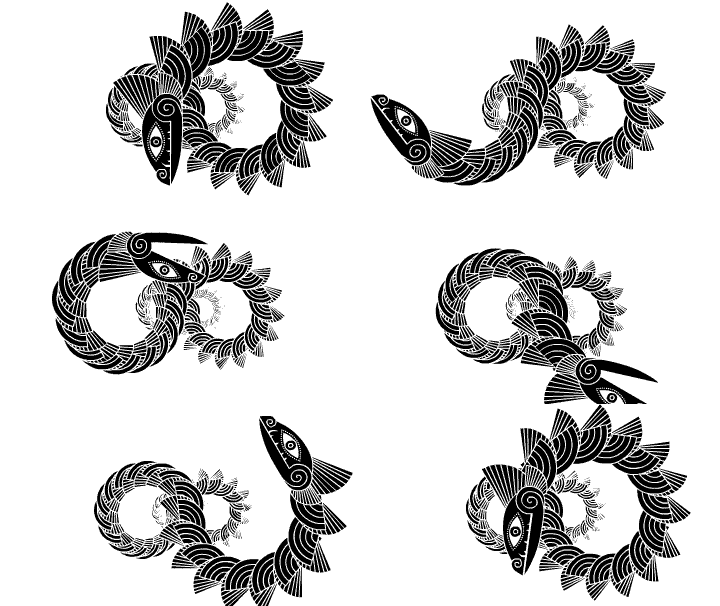 Nina writes: Some infinities are bigger than others. This Leviathan has a few extra receding loops, making it more infinite than the version I posted earlier.
