Image

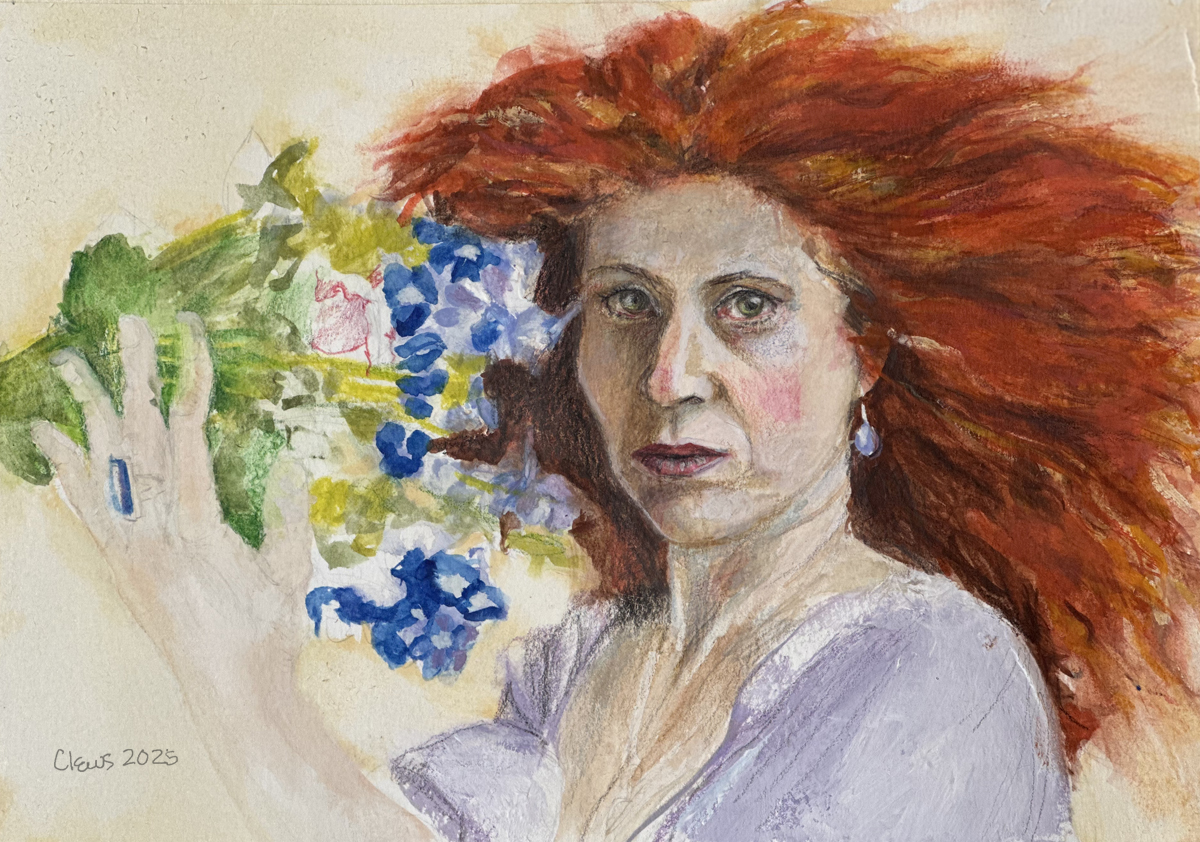
RUBIES IN CRYSTAL

Does language hover between my nerve endings and the world, or is language my skin itself?
Sheath of feeling. Words groping to touch air.

Seder Masochism by Nina Paley

Isn't this gorgeous?! Look at the motion all the way through, and those hind legs! Even the paws return back, with their claws, and not in perfect unison. Wow. Brilliant. Created by Nina Paley.

I'm loving this one too:


Now Even More Infinite

Nina writes: Some infinities are bigger than others. This Leviathan has a few extra receding loops, making it more infinite than the version I posted earlier.


Home  Green Fire  Different, yet Same  Soirée of Poetry  Videopoetry  Celestial Dancers  Photopoems  Birthdance  Bliss Queen  Bio  Life Drawings  Earth Rising  Creative Process  Multiplicities  Links  Comments
Comments

FRIDAY VIDEO/FILM POEM: Sylvia Plath's 'Lady Lazarus' and 'Daddy'

These older gems have been on YouTube for 5 or 6 years. The first, Sylvia Plath Reads Lady Lazarus, has about a quarter of a million views; the second, Sylvia Plath Reads 'Daddy,' is in the half a million range. In the world of video/film poetry, these two flicks are superstars.

Unfortunately they come to us without any filmmaker information. Who made them? Who is the actress? That information was not recorded, or was cut off, when they were copied from British television at least 20 years ago or longer and later transferred to a format for uploading to YouTube. I was unable to find anything on their origin after an afternoon of looking on-line, but am very glad that these film poems are there for us to see.

Each film uses Sylvia Plath's own readings of her poems. Her readings are as powerful, intense, and gripping as her confessional poetry. Both were recorded by the BBC shortly after they were written. The power that drove her to write them is, to my ear, in her voice as she reads them. The cauldron of her creativity was still on fire. They are riveting, strong poems on the page, and aurally. I would have liked to see her as she read her poetry that day, but we can only imagine her presence.

Sylvia Plath, as many readers might know, was a talented poet who was married to Ted Hughes and who bore two children with him. After they separated, Plath awoke before dawn each day and wrote her most inspired poetry, collected in the slim volume, Ariel. She committed suicide by turning on the oven after blowing out the pilot light and blocking the drafts under the doors while her children slept. Her death ricocheted her to posthumous fame. She has been an immensely popular and influential poet for almost 50 years.

Her final poetry arises out of a world that is still dealing with the massive and inhumane deaths during the war. Coming to grips with the Holocaust, for instance, a painful and sensitive issue, was especially acute in the post-war period. Plath's father was German, and she not only felt abandoned at 8 years of age when he died, but he became symbolic of the Nazi spirit to the young poet who identified with the Jewish people who were gassed to death in the concentration camps. 'Daddy,' the second film poem below is an indictment not only of Nazi Germany but of the horrors its descendants deal with.

Plath is a lyrical poet whose "I" becomes the "I" of a crazed humanity on the brink of destruction, even as she wills her horse, Ariel, "Into the red /Eye, cauldron of morning."

The film poem, Sylvia Plath Reads Lady Lazarus, opens with an image of one of her poems, in reverse - white writing on black. It is a rough draft of Lady Lazarus and we can see how she worked and re-worked her poems, scratching words out, re-writing until they sang to her with dark intensities. She had attempted suicide a number of times in her life and refers to her ability to come back to life; like Lazarus that Jesus brought back from the dead, she is "A sort of walking miracle," "And like the cat I have nine times to die." In the film poems, lights appear and disappear in the darkness that is a continuing motif throughout both pieces. Lady Lazarus is mostly black and white, but when colour appears, it is iridescent. Sylvia bitterly states, in what are surely the most famous lines of the poem, "Dying /Is an art, like everything else. /I do it exceptionally well." Images come and go almost like pictures flung on the wall by turning lamps, reflected, meeting the poem, retreating into the darkness. Photographs of Sylvia appear in the film, and they are haunted by her speaking. And there is an actress, a beautiful woman, who appears and disappears, a woman who might be "the same, identical woman":

I am your opus,
I am your valuable,
The pure gold baby

That melts to a shriek.
I turn and burn.
Do not think I underestimate your great concern.

Ash, ash---
You poke and stir.
Flesh, bone, there is nothing there----

A cake of soap,
A wedding ring,
A gold filling.

Herr God, Herr Lucifer
Beware
Beware.

Out of the ash
I rise with my red hair
And I eat men like air.


Sylvia Plath Reads Lady Lazarus

"This video is an excerpt from a television arts documentary from about fifteen years ago. The images are very haunting and compliment the poetry extremely well." presumably the original uploader,  mishima1970, in a comment 5 years ago

The BBC tells us (where you may read and listen to the longer poem in its entirety), "This powerful reading was recorded for the British Council only days after the poem was written and is slightly longer than the version published posthumously in the collection 'Ariel'."


Sylvia Plath Reads 'Daddy'

"It IS Sylvia Plath reading it, and it is the official BBC recording from 1962. She recorded about twenty poems in her own voice, and this is one of them." presumably the original uploader, mishima1970, in a comment 4 years ago

If you would like to hear "Sylvia Plath interviewed by Peter Orr of The British Council - 30th October 1962," try here: http://youtu.be/S-v-U70xoZM before YouTube removes it for copyright violations (as it has done with other sites that also presented this material), unless, of course, the interview is now in the public domain (I was not able to certify this in an Internet search).

Because I don't wish to make this article too long, briefly I will say that the film poem, Sylvia Plath Reads 'Daddy,' crosses genres from a poetic rendition of a poem to a documentary. In it we find not only stock footage from the war of Nazi soldiers marching, and the terrifying transport trains for Jewish people sent to the concentration camps, but images from Sylvia's life float up at us - pictures of her during her life, a child here, a beautiful young woman there, scenes with her father and mother, her husband, Ted Hughes, even her father's gravestone. Like her poetry, which interweaves personal biography with horrendous political events, an intimate drive towards death by suicide with a collective desire to kill as shown by the scope of World War II, the film poem interweaves collected images of the poet's life with poetic images and film from the war itself. To say masterfully done barely describes this film poem. After you watch it you will understand why it has had 559,037 views and counting.


Home  Green Fire  Different, yet Same  Soirée of Poetry  Videopoetry  Celestial Dancers  Photopoems  Birthdance  Bliss Queen  Bio  Life Drawings  Earth Rising  Creative Process  Multiplicities  Links  Comments
Comments (2)

Video Poetry: Voicings


Voicings by Brenda Clews

Besides reading it at a poetry event last week, I videoed 3 rehearsals, and memorized it for this videopoem of Voicings, a prose poem that I wrote some years ago and revised recently. This poem also made it to the top of SoundClick's Poetry charts in 2007.

Is there anything wrong with the lowly poetry reading? Attending poetry readings is one of my favourite activities. Perhaps that enjoyment carries across. With my own videopoetry, when I perform a piece, it garners more views than my videos of imagery with a voiceover. I cannot do it - show myself - without a sense of humour, though.

However, for once I didn't obscure the realism of the camera and instead allow myself to be seen. The reading is virtually untouched footage straight from the camera.

My fascination with multiplicity, multiples remains, though. Nodes, modules, events, thoughts, memories, everything is intersecting, widely missing the connection, intwined, separated, in the flow together or opposing each other. Vectors pulse everywhere in an ongoing processes of embodiment, momentary materializations.

We are layered, enfolded. I am composed of at least two, and usually more. My dopplegängers often show up in my videos; sometimes they get carried away and dance the words of the world. Ventriloquist, yes, but the main figure speaks and she, the double, explains. Like captions. Or perhaps she is the emotion within the words. The spirit fighting to get out. Anyway, she takes over at the end, dancing, and some of the colours and shapes remind me of ancient Sumerian myth, and Polynesian spirit charms.

She is Semiotic, rhizome, an off shoot of the woman speaking of words in a worded world.

That is a solid silver Sari wedding belt that I am wearing as a necklace. I only wear it on special occasions.

Likely I will spend hours subtitling this, but not now. So here is the prose poem:


Voicings

voices, buzzing paths, the expanse we walk through, dark, hoverings in the distance like our hidden thoughts, climbing the insides of our minds, echo chambers, repetitions, stress points, gasps, retreats, revolving around and around, circling,

spinach and feta cheese and pink salmon, sanpellegrino limonata, juices, absorbing, digesting, flowing to all cells, hollow drums, rain sticks beating on the inside, slipped discs, swollen tissue, torn hearts healing,

voices, fragments of conversations, hearing pathways, following lines of letters, words randomly interspersed, little collections of refuse, humming things, what's being said and what's being thought at variance, then laughter,

a music, endless conversations in all minds in all places, air, water, land, cities, streets, buildings, rooms, film and tv and computer screens, talking, echoing, blaring, string-theories of words accompanying the world’s activities, thought flying through words, fleshed words, graced words, like balls flying far beyond the baseball bats in the floodlit diamonds, and racing, running, billowing in the green grass blue sky up into outer space,

billions of conversations, no stopping, the telling, others, ourselves, reams, skin of naked words, a love of words, conceptualizations, significations, words that are real, sensual, rolling, synaesthetic experiences, how our tongues love to form sweet angry hot explanatory seductive smart gossipy sophisticated kind compassionate judgmental searing truthful words for speaking, writing, dreaming,

and when yours and my words meet, from my lips to your ears, from your lips to my ears, in the air trance entrance  ringing cymbals  crystal singing,  guttural, ethereal,  whispering, our longing, who cares what we say, ecstatic light levitating, our tongues interlinking, ruby flame of our bodies, our
hearts speaking,

-
Also, I composed the background soundtrack in GarageBand.


Home  Green Fire  Different, yet Same  Soirée of Poetry  Videopoetry  Celestial Dancers  Photopoems  Birthdance  Bliss Queen  Bio  Life Drawings  Earth Rising  Creative Process  Multiplicities  Links  Comments
Comments

A snap-shot of a group of writers and musicians...


Courtney Park Library, Nov. 26th - GREAT POETRY EVENT!

From left to right, Nik Beat, Brenda Clews, Brandon Pitts, ParisK Black, Jennifer Hosein, Tallulah Doll, and Susan Munro... Brandon's book of poetry, Pressure to Sing, was launched, and the rest of us read or recited or sang in an interspersed open stage (between the three book launches)... it was a great afternoon!

And a daytime shot like this... rare.

Home  Green Fire  Different, yet Same  Soirée of Poetry  Videopoetry  Celestial Dancers  Photopoems  Birthdance  Bliss Queen  Bio  Life Drawings  Earth Rising  Creative Process  Multiplicities  Links  Comments
Comments (2)

FRIDAY VIDEO/FILM POEM: 'Caldo de cultivo/Culture Medium' by Phillipe and Lola Miralles


Caldo de cultivo from Lola Miralles on Vimeo.

The Spanish original. And an English translation (how lovely is that?). It's an amazing video and those of us who speak and read English are very appreciative!


Culture Medium from Phillipe on Vimeo. Subtitled in English.

This film is powerful and primal. It moves by scenes that appear as surreal representations of a poem that is postmodern, and emerges from the depths of the maternal terrain. The poem struggles with birth, the body, the subjectivity of the mother/the writer, what creativity is. We never see a child, thankfully. In the history of art, birth was always about the child, the divine child. The mother's experience was invisible. She was merely the receptacle for the new subject, she through which the citizen was born.

In Caldo de cultivo/Culture Medium, we begin with that richest of mantles, that umbilical sky of nutrients, the placenta, or, rather, a mass of weeds lapping in the waves that appears placental. It is a surprisingly realistic image. It is hard to look at, the mass of veins and arteries through which nutrients flowed from the mother to the child in utero and the waste that flowed back to be dispersed in her body. It is there, floating on the salt water, expelled; Caldo de cultivo/Culture Medium begins with the afterbirth.

In the thumbnail still for the video, we see Lola, the poet herself, the shadow of the poet, curtains of light and something round, like a moon, or a paper lantern. That image appears and disappears in the scenes where we see Lola's silhouette, right way up or upside down, against the curtains. Is the round shape in the curtains an accident? Or a representation of the pregnant belly? Lola is not pregnant in the film poem. Yet her poem dredges through maternal imagery.

Phillipe is an artist turned filmmaker. An artist who feels that painting had come to its end, that art galleries are museums of history. His films are a type of multi-media painting. He creates collages, assemblages with his camera and his film editing. Caldo de cultivo/Culture Medium explores the maternal terrain and the mute mother. But not directly. This makes his work truly brilliant.

She is silent behind a net. The beautiful Spanish poet gazes at us behind a white net. She does not speak in the film, though we read her poem. And what a poem it is! We read cryptic words written in the mother's voice. She who is silent speaks. It is a difficult speaking, the maternal terrain is resistant to the language of culture.
And in the girdle. Rip the hard fabric and get to the flesh, tear the flesh, let one among so many that still have to be find the tortured way (but so lively), under the sheets to give the final blow of air needed for the harvest there where the tenderness of fluids found the seed progression sprouting with no miracles. There is a nauseating garden in the entrails of my bed.
Phillipe's filmic images are strange, Surreal and superbly attuned to the core of the poet and her poem.

The hand-held camera walk through the sand of the dunes with the immediacy of the depth-soundings, the clicking that is like a heartbeat of the soundtrack reminded me of travelling, into life perhaps. The footprints, others have gone before. Then the sea wind blowing the poet's hair in the room silhouetted against the curtains of light, and that moon shape that seems embedded in the scene by the filmmaker. The film is a visual poem by the filmmaker, by Phillipe. Back in the sand, we come to seagrass that, given the poem, the opening image that is like placental "entrails,"appears to my eye as pubic hair growing on the body of the mother become as large as the earth. We see the shadow of the filmmaker, and again, I feel he is foreshadowing his birth. Birth is metaphor for many things, isn't it.

Back to the mute and beautiful Spanish poet behind the gauze, or netting, she asks us 'not to look "in the corny reflection/ of the ethereal and fanciful divas." This I read as the woman portrayed by the artist as femme fatale, as reflection of a male gaze and desire, misses the point. The mother is the mute founder of culture, a culture that ignores her, and silences her - except if she can speak as a "fanciful diva." Her deep knowledge of life and death may not cross the tongue of words.

We are in a "reflux that weaves" in a windowless room of walls. There is anger in the writing (though not in the steady gaze of the beautiful poet): "The spleen that comes out when they try /to tear us apart from the child." The ropey veins, entrails, threat of being 'girdled' appear as the poet playfully rubs a nest of rope about her head: "And in the girdle. /Rip the hard fabric and get to the flesh, /tear the flesh." The section of the poem that I quote above appears in the subtitles while the poet plays with the tangled rope.

We are deeply in embodiment, in "the tenderness of fluids." Again, I find the use of the word, "fluids" brings me into deep memory of the maternal body and its mess of fluids, spittle, waters, colostrum, milk, and the baby's fluids. The poem says, "the seed" sprouts "no miracles." The shots of her eyes is brilliant at this moment when we reflect on what she has seen, her wisdom, the knowledge of the mother who gives birth.

The beach in the darkening light, and the base of the tree trunk calls to mind the tree of life, what upholds, and the camera, our sight, revolves under the shadows of the leaves of this tree. The lace of light through the silhouetted leaves again visually echoes the ropey textures of earlier images.

Probably the central lines of the poem are: "There is a nauseating garden /in the entrails of my bed." Lola Miralles speaks them directly to the camera and to the audience of the film. It is the only time she speaks in the whole film.

Then she is portrayed sideways, in a white sheet, behind small sticks and perhaps wire or rope. Is she giving birth? Is she lying in corpse pose? We do not know: "The waste of the helpless body /found mother soil." And, yes, "growing under the sun of the buttocks, /nurtured by all worldly secretions." The placental, birth canal image of bleached pubic hair like tiny stands of rope that appears next is pure Surreality. The hollow cave from which we all emerged is there, "blood, /bile, /sweat, /flux, /breath."

Then we re-enter the garden. Is it Eden? It shifts and moves in 'flux' like the opening placental weeds. "The young vine trunks are now thick /enough to have sons like shoots /where fruit is bursting green." The film is black and white, there is no colour. It is stark, and strange.

The final image is Frida Kahlo-like. Our Spanish beauty lies in an embroidered white nightgown on a bed of white sheets in corpse pose and the sheet is pulled back from her by unseen hands: "One more push and done, /the birth in the linen." Then she is upright with her eyes closed, and draped in strands of linen, or cloth. She is Madonna-like, and lifts a branch of leaves up over her head and out of the picture frame, "Not the first harvest of smooth golden grapes /cultivated in manure, though." A wind blows.

A film poem to take your breath away with its profundity and beauty.

Caldo de cultivo/Culture Medium: Actress and poem by Lola Miralles; scenery and production assistance by Kenneth Pilgrim; filmed in Alicante and Urbanova, Spain, and Beverley, England; directed, and filmed and edited by Philip David Edson.


Home  Green Fire  Different, yet Same  Soirée of Poetry  Videopoetry  Celestial Dancers  Photopoems  Birthdance  Bliss Queen  Bio  Life Drawings  Earth Rising  Creative Process  Multiplicities  Links  Comments
Comments (9)

Rehearsals for a videopoem


Perhaps I like to prevent the viewer from forming a generalized view of whatever my 'identity-presence' is. Part of this is accomplished through humour, which distances recursively, meaning boomerangs in its iterations. The selves operate this way. We are crowds. You, too, are composed of opposites and different stagnancies and transformations at various speeds in vectors as you focus in this moment, here. How often do we cystalize?

When are we ever all in one place?

At death, perhaps. But, by then, we have fled elsewhere.

So, rehearsals. Preparations for the public show. Experiments, tests, and yet are we not rehearsing every moment of our lives? Learning how to live. In our becoming art?


Rehearsal Two is what I thought I'd like to do. Strong light so you can see only half the face, all black otherwise. Both were shot with the internal iSight camera in the iMac, the first via Photobooth, and the second via iMovie. Not great detail, but ok for test runs.

In some ways I prefer the setting and tone of Rehearsal One, but the Two has a stark simplicity that I like too. Rehearsal Three, a combination of Rehearsal Two and another one I did in Photobooth is a bit strange, and my sense of humour has crept out. It's my favourite, however, and so I put it first.


Above, the link to the first rehearsal, when I hadn't quite memorized the prose poem.

Below, the one I did when I got home on Wednesday night, and that was turned into black and white for Rehearsal Three, up above.


_


The final version of Voicings is here, and it is similar to Rehearsal Three above, only I didn't obscure the realism of the camera and instead allow myself to be seen.

Where I read the poem on an open stage:


Courtney Park Library, Nov. 26th - GREAT POETRY EVENT!

From left to right, Nik Beat, Brenda Clews, Brandon Pitts, ParisK Black, Jennifer Hosein, Tallulah Doll, and Susan Munro... Brandon's book of poetry, Pressure to Sing, was launched, and the rest of us read or recited or sang in an interspersed open stage (between the three book launches)... it was a great afternoon!

And a daytime shot like this... rare.


Home  Green Fire  Different, yet Same  Soirée of Poetry  Videopoetry  Celestial Dancers  Photopoems  Birthdance  Bliss Queen  Bio  Life Drawings  Earth Rising  Creative Process  Multiplicities  Links  Comments
Comments

FRIDAY VIDEO/FILMPOEM: 'Saltwater' by Glenn-emlyn Richards


Saltwater (2011) from Glenn-emlyn Richards on Vimeo.
A collaboration with poet Eleanor Rees. Reading by Lindsay Rodden.

You will watch this, fascinated. And you will return to the film poem and watch again, and it will seem new, as if you had not seen all of it before. Each time you do this, it will be as if you had not seen it before. Did I watch this? Yes, of course. And yet it is provoking new insights, more marvel. How does a film do that?

Between the reader, the poet, and the filmmaker artist, magic occurs. She is like Botticelli's Venus, is that why we are so transfixed? But she is an India ink figure, and not a fine Renaissance painting. The film work, the editing, brings her alive. How does her hair flow with the waves of the saltwater sea? Is it the call of the ocean itself?

Glenn-emlyn Richards had created a one of the finest film poems. I treated a group to a series of video/film poems, only a few, because they tired very quickly - poetry is demanding enough on the page, let alone strung at you in a video where you can't slow down, re-read, consider before moving on - but someone said, the one with the woman, the drawing, the ocean, that one was my favourite. In unison, they all agreed.

The animated images of the video travel like an imaginary documentary with images of the poem, but not with a photorealism. Rather we are in a world of the imagination of our world in both the poem and the film. Art on art. The way we cohere and collect our experiences in the artifice of our art presented without guile, simply.

The simplicity unravels us. We fall in love with the film poem. That one we want to keep, starred, bookmarked. But it passes away, as all things must.

And so I collect it here for you, so you may come back and journey again on the sea of Saltwater.

_
Glenn-emylin Richards, is a graphic designer, English television director, independent film-maker and musician. His films have been shown at many poetry film festivals. He currently lives in Normandy, France: wodum.co.uk/.
Eleanor Rees is an award-winning British poet and teacher of creative writing living in Liverpool. Lindsay Rodden is an Irish actress, playwright and author.


Home  Green Fire  Different, yet Same  Soirée of Poetry  Videopoetry  Celestial Dancers  Photopoems  Birthdance  Bliss Queen  Bio  Life Drawings  Earth Rising  Creative Process  Multiplicities  Links  Comments
Comments (4)

International Day for the Elimination of Violence Against Women


direct link: PL: P(ink) L(ady)

For "International Day for the Elimination of Violence Against Women," which is today, November 25th.

Home  Green Fire  Different, yet Same  Soirée of Poetry  Videopoetry  Celestial Dancers  Photopoems  Birthdance  Bliss Queen  Bio  Life Drawings  Earth Rising  Creative Process  Multiplicities  Links  Comments
Comments

Language is the cage though which I express my passion


"LANGUAGE IS THE CAGE THROUGH WHICH I EXPRESS MY PASSION" 21cm x 29cm, 8" x 11.5", 2011, India and acrylic ink, gel pen, oil paint on Moleskine Folio Sketchbook A4 prepared with a base of acrylic matte medium.

After I had finished my NaNoWriMo writing early (10pm), and read some older poems I'd written, I got out my inks and paints... was up rather late with this Moleskine poem painting, tired today.

Among my papers were some prose poems I wrote on language some years ago and I suddenly felt an urge to break through language. Only, of course, you can't. Even visual representation, of any kind, is a pictorial language, learnt like anything else. But - the heart beating with its passion in the rib cage. The rib cage spread out in many (semiotic) lines. The dancer is an awkward figure, half harlequin I think, and eyes appeared in her breasts, which was unintended but apt. That rib cage became all of language invigorated (or enervated?) by our passion. It was a drawing I did thinking about these things, and perhaps it's a chart of them.

(Above and below were responses to comments at G+ by Raven M. Ridley and Larry Ayers, but way more than they asked.)

To me, she is a Spanish woman, don't ask why, in ballet shoes en pointe, with half a black skirt, only half, black hose to the ankle on the other bent leg, one arm clearly up, and wearing a corset with ribs (in which there are eyes). I thought of Frieda Kahlo when I added the red, again, no reason, can't answer why. The lines were like bobby pins springing outwards and opening. Her long black hair coming undone? Who knows.

And yet the heart remains in the rib cage; passion remains in the language that expresses it. I was thinking about Wagner's music, that Germanic passion, and the use of Tristan and Isolde in von Trier's latest film, Melancholia which I saw on the weekend, and Almodóvar, the Spanish director and the intense passion in his films. The blue is the sky, because we are always dancing in the sky.

What goes through an artist's mind while they are drawing or painting...

Home  Green Fire  Different, yet Same  Soirée of Poetry  Videopoetry  Celestial Dancers  Photopoems  Birthdance  Bliss Queen  Bio  Life Drawings  Earth Rising  Creative Process  Multiplicities  Links  Comments
Comments

The Falling Room - Nov 18th show

Halder offers these downloads of his radio show, The Falling Room, every week, and I really enjoy them during long night walks. Sharing, and not just because I'm in this one (it was a surprise this morning):

The Falling Room – November 18, 2011

This week’s show starts with three world fusion pieces; Lumin’s work “Lumin” and two compositions from Irfan titled “Salome” and “Monsalvato”.

Next is a well known Canadian artist to The Falling Room, The Violence and the Sacred, with their 1987 highly experimental piece “The Rivers of my Viscous Sperm” from the Lost Horizons CD. Another Canadian artist follows, Reinhard Von Berg with “Cult Figure” which completes the first half hour of the program.

The next half hour of The Falling Room continues with poet/artist Brenda Clews, with “What is Underground Is What Holds Us” from her Starfire album and Tetrix with “Imagination”.

I end the show with two tracks from the Polish artist Sulatus, from his new Tip album I present “Poland’s Sky” and “Not Sure”.


You can download the November 18, 2011 TFR here.

Please feel free to share the program with other artists or interested listeners.

Thank you for listening.
Joe (aka Halder)
Host and Produce of the Canadian Experimental Music Radio Program - THE FALLING ROOM
Broadcast live on Fridays at 8PM and repeated Tuesdays at Midnight on 103.7FM CFBU Radio


Joe has played a number of poems from my Starfire album, here is the one he played last Friday (in case you don't want to download the whole hour, I wasn't sure - this player is easy to embed).

Home  Green Fire  Different, yet Same  Soirée of Poetry  Videopoetry  Celestial Dancers  Photopoems  Birthdance  Bliss Queen  Bio  Life Drawings  Earth Rising  Creative Process  Multiplicities  Links  Comments
Comments
Apr 2025
Feb 2025
Jun 2024
Apr 2024
Aug 2023
Oct 2022
May 2022
Oct 2021
Sep 2021
Jul 2021
May 2021
Jan 2021
Oct 2020
Aug 2020
Jul 2020
Jun 2020
May 2020
Dec 2019
Sep 2019
Aug 2019
Jul 2019
May 2019
Apr 2019
Feb 2019
Jan 2019
Nov 2018
Sep 2018
Aug 2018
Jul 2018
May 2018
Apr 2018
Mar 2018
Feb 2018
Jan 2018
Dec 2017
Nov 2017
Oct 2017
Sep 2017
Aug 2017
Jul 2017
Jun 2017
May 2017
Apr 2017
Mar 2017
Feb 2017
Jan 2017
Dec 2016
Nov 2016
Oct 2016
Sep 2016
Aug 2016
Jul 2016
Jun 2016
May 2016
Apr 2016
Mar 2016
Feb 2016
Jan 2016
Dec 2015
Nov 2015
Oct 2015
Sep 2015
Aug 2015
Jul 2015
Jun 2015
May 2015
Apr 2015
Mar 2015
Feb 2015
Jan 2015
Dec 2014
Nov 2014
Oct 2014
Sep 2014
Aug 2014
Jul 2014
Jun 2014
May 2014
Apr 2014
Mar 2014
Feb 2014
Jan 2014
Dec 2013
Nov 2013
Oct 2013
Sep 2013
Aug 2013
Jul 2013
Jun 2013
May 2013
Apr 2013
Mar 2013
Feb 2013
Jan 2013
Dec 2012
Nov 2012
Oct 2012
Sep 2012
Aug 2012
Jul 2012
Jun 2012
May 2012
Apr 2012
Mar 2012
Feb 2012
Jan 2012
Dec 2011
Nov 2011
Oct 2011
Sep 2011
Aug 2011
Jul 2011
Jun 2011
May 2011
Apr 2011
Mar 2011
Feb 2011
Jan 2011
Dec 2010
Nov 2010
Oct 2010
Sep 2010
Aug 2010
Jul 2010
Jun 2010
May 2010
Apr 2010
Mar 2010
Feb 2010
Jan 2010
Dec 2009
Nov 2009
Oct 2009
Sep 2009
Aug 2009
Jul 2009
Jun 2009
May 2009
Apr 2009
Mar 2009
Feb 2009
Jan 2009
Dec 2008
Nov 2008
Oct 2008
Sep 2008
Aug 2008
Jul 2008
Jun 2008
May 2008
Apr 2008
Mar 2008
Feb 2008
Jan 2008
Dec 2007
Nov 2007
Oct 2007
Sep 2007
Aug 2007
Jul 2007
Jun 2007
May 2007
Apr 2007
Mar 2007
Feb 2007
Jan 2007
Dec 2006
Nov 2006
Oct 2006
Sep 2006
Aug 2006
Jul 2006
Jun 2006
May 2006
Apr 2006
Mar 2006
Feb 2006
Jan 2006
Dec 2005
Nov 2005
Oct 2005
Sep 2005
Aug 2005
Jul 2005
Jun 2005
May 2005
Apr 2005
Mar 2005
Feb 2005
Jan 2005
Sep 2004
Jun 2004
May 2004
Oct 2003
RSS Feed