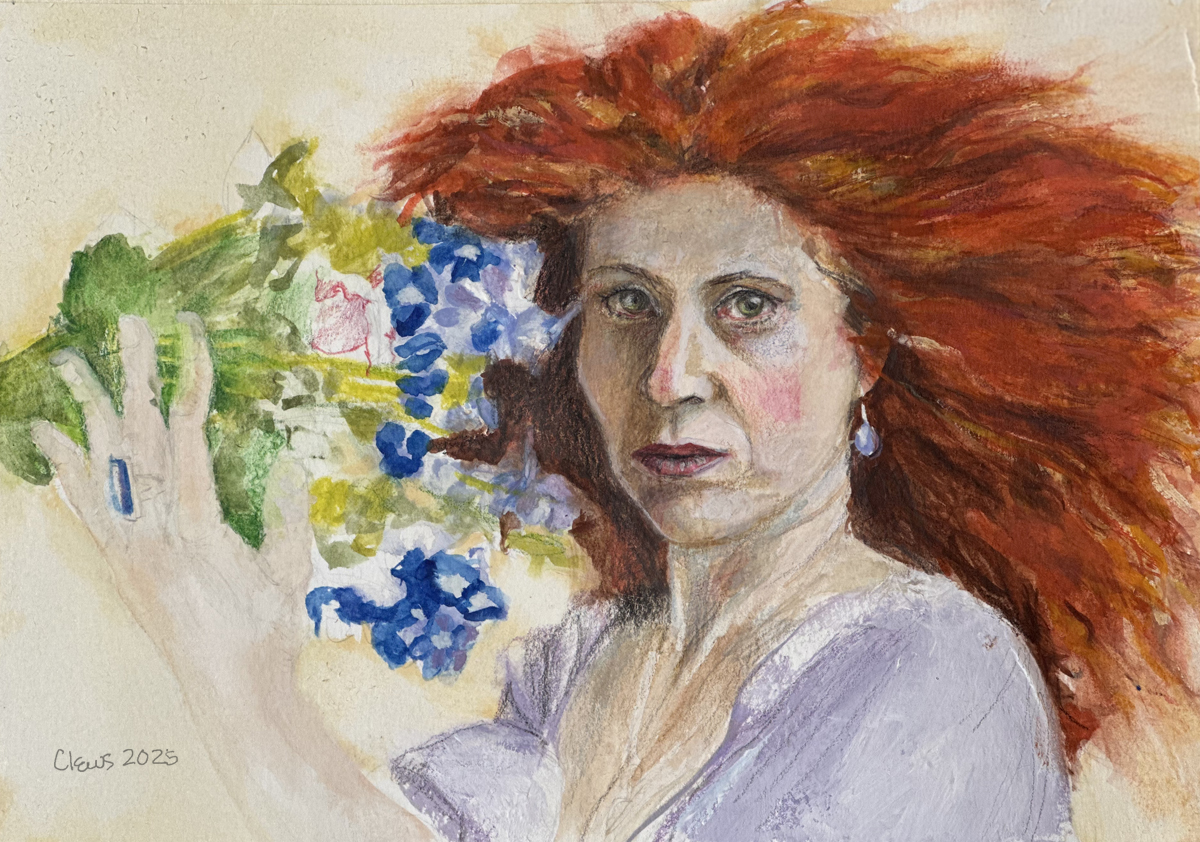
RUBIES IN CRYSTAL
Does language hover between my nerve endings and the world, or is language my skin itself?
Sheath of feeling. Words groping to touch air.
Tidal Patterns
%724 %UTC, %2006, %0:%Oct %ZIt wasn't always this way. One upon a time the tide remained high. And there were no clams or seaweed to be found and the Tsimshian went hungry. Raven knew what lay under the blue glistening robes of water.
When he wrapped his blanket of black feathers around his strong shoulders, he flew. His sharp eyes watching, looking. Scanning the edges of the ocean, he found her.
Tightly she held the tide-line in her hands. She wouldn't release the ocean to rhythmically rise and fall on the beach, or draw back from it, leaving washed treasures, clams, seaweed, shells, shiny pebbles.
Why did the old woman hold the tide-line so tightly in her lined, papery hands? She sat in her small house on the edge of the sea, holding the waters in the life-line on her palms. Who can tell from the mass of mounds and lines on her hands how she bid the edges of the great water be still?
Inside her sun-bleached house with closed eyes she imagined the ocean, or perhaps she could see it with visionary sight. She sat, the tide-line, her hands, the one interconnected with the other, like a fisherman's net, weeping tears of salt.
Raven dropped from the sky, a shadow of black feathers. He sat down beside her and groaned, holding his belly, saying he had eaten too many clams. He broke her meditation, and she stood, and went to look at the clams, but he pushed her and she fell. Then he poured sand in her eyes so that she was blinded. Pulling the tide-line out of her hands, tearing the life-line from her, he released the hold on the waters and the tide at last fell.
Crazy old woman on the edge of the ocean of time, time's burden, that weight of life-giving water.
And so the ocean drew back its mantle of blue robes and the people feasted.
There were bonfires on the beaches and a festival of clam bakes that lasted days until everyone's bellies were swollen full of food.
Who was the blind old woman crying on the beach with the torn hands?
Raven in his raucous joviality passing from one feasting party to the next found himself before the old woman, who spoke, "Raven, heal my eyes so I may see again." Raven, trickster-figure, Promethean fire-stealer, knew the Gods could must be bargained with, appeased. He struck a deal: "Old woman of the sea, I will heal you, but you must promise to let the tide-line go twice a day so that the people may gather food from the beaches." The old woman agreed and so he rinsed the sand out of her eyes. Thus Raven ensured the life-lines of the people, their continuity.
In my story, as I walk the empty beach strewn with empty clam shells, seaweed, the detritus of modern civilization, I want to find her, and find out why, the witholding.
I want to know why she denounces me, or those like her.
And take the cawl she has wrapped me in off: to breathe, to see.
But I spin like Tiresias under an unrelenting sun.
Why do black feathers lie strewn in my hair?
My eyes, gritty and sore, are on fire -
I see only flaring volcanoes
A red rage of light;
On this windless day
How did my eyes fill with sand?
My hands bleed as I write.
For what do I weep?
When he wrapped his blanket of black feathers around his strong shoulders, he flew. His sharp eyes watching, looking. Scanning the edges of the ocean, he found her.
Tightly she held the tide-line in her hands. She wouldn't release the ocean to rhythmically rise and fall on the beach, or draw back from it, leaving washed treasures, clams, seaweed, shells, shiny pebbles.
Why did the old woman hold the tide-line so tightly in her lined, papery hands? She sat in her small house on the edge of the sea, holding the waters in the life-line on her palms. Who can tell from the mass of mounds and lines on her hands how she bid the edges of the great water be still?
Inside her sun-bleached house with closed eyes she imagined the ocean, or perhaps she could see it with visionary sight. She sat, the tide-line, her hands, the one interconnected with the other, like a fisherman's net, weeping tears of salt.
Raven dropped from the sky, a shadow of black feathers. He sat down beside her and groaned, holding his belly, saying he had eaten too many clams. He broke her meditation, and she stood, and went to look at the clams, but he pushed her and she fell. Then he poured sand in her eyes so that she was blinded. Pulling the tide-line out of her hands, tearing the life-line from her, he released the hold on the waters and the tide at last fell.
Crazy old woman on the edge of the ocean of time, time's burden, that weight of life-giving water.
And so the ocean drew back its mantle of blue robes and the people feasted.
There were bonfires on the beaches and a festival of clam bakes that lasted days until everyone's bellies were swollen full of food.
Who was the blind old woman crying on the beach with the torn hands?
Raven in his raucous joviality passing from one feasting party to the next found himself before the old woman, who spoke, "Raven, heal my eyes so I may see again." Raven, trickster-figure, Promethean fire-stealer, knew the Gods could must be bargained with, appeased. He struck a deal: "Old woman of the sea, I will heal you, but you must promise to let the tide-line go twice a day so that the people may gather food from the beaches." The old woman agreed and so he rinsed the sand out of her eyes. Thus Raven ensured the life-lines of the people, their continuity.
In my story, as I walk the empty beach strewn with empty clam shells, seaweed, the detritus of modern civilization, I want to find her, and find out why, the witholding.
I want to know why she denounces me, or those like her.
And take the cawl she has wrapped me in off: to breathe, to see.
But I spin like Tiresias under an unrelenting sun.
Why do black feathers lie strewn in my hair?
My eyes, gritty and sore, are on fire -
I see only flaring volcanoes
A red rage of light;
On this windless day
How did my eyes fill with sand?
My hands bleed as I write.
For what do I weep?
Comments (4)
Simple Yoga this Morning
%489 %UTC, %2006, %0:%Oct %ZEarly this morning I pulled out my yoga mat (a sheepskin bought in 1994 and for which I sewed a case out of peach-coloured upholstery fabric as many years ago), laid it on the floor (a very tight fit since I live in a closet), and did this yoga set: Spinal Flex Series.
I began my day with this simple yoga set for the spine for many years - sure it got boring, but different music every day helped. Today, as I flex back and forth, I feel how stiff I've become, how I need to loosen, to take care of this Sushumna, central column, spine, place where all the nerves, nadis, meridians flow. I feel the weight of what I carry as I rhythmically flex, especially when I get to the 'shoulder shrugs,' eh, let the tension go, let it go...
Each day is new, life is strange, but it keeps going. Perhaps I shall still be sitting on my mat, flexing my bent old spine when I am a centenarian, shrunken, withered, wrinkled, but ever so wise :-)
Thinking of you, I got out my old scanner with the crack in the lid, started it up, scanned these sets at least 3 times to get a clear image. My friend who was in her 30s and had pain in her back that was finally diagnosed as arthritis and had physiotherapy sessions let me teach her this set one afternoon when our then younger children were in school and she marveled at it. A few weeks later after doing the set daily she asked, 'Why don't Physiotherapists teach these exercises? This flexing really works, really helps.'
Are we as young as our spine is flexible? It's okay, I won't go into 'yoga teacher mode' and lecture on the spine. Let's just say that all of the billions of nerve cells in our bodies are connected to our brains through the braid of nerves running through the spinal column. If nothing else, keep this central part of your body flexible, in motion, healthy...


Kundalini Yoga: Guidelines for Sadhana (Pomona, California: Kundalini Research Institute, 1974), p.45-6. For another layout of this set, see Basic Spinal Series, and scroll to the end to read a description of Mul Bhand (root lock) and Maha Bhand (great lock).
I began my day with this simple yoga set for the spine for many years - sure it got boring, but different music every day helped. Today, as I flex back and forth, I feel how stiff I've become, how I need to loosen, to take care of this Sushumna, central column, spine, place where all the nerves, nadis, meridians flow. I feel the weight of what I carry as I rhythmically flex, especially when I get to the 'shoulder shrugs,' eh, let the tension go, let it go...

Each day is new, life is strange, but it keeps going. Perhaps I shall still be sitting on my mat, flexing my bent old spine when I am a centenarian, shrunken, withered, wrinkled, but ever so wise :-)
Thinking of you, I got out my old scanner with the crack in the lid, started it up, scanned these sets at least 3 times to get a clear image. My friend who was in her 30s and had pain in her back that was finally diagnosed as arthritis and had physiotherapy sessions let me teach her this set one afternoon when our then younger children were in school and she marveled at it. A few weeks later after doing the set daily she asked, 'Why don't Physiotherapists teach these exercises? This flexing really works, really helps.'
Are we as young as our spine is flexible? It's okay, I won't go into 'yoga teacher mode' and lecture on the spine. Let's just say that all of the billions of nerve cells in our bodies are connected to our brains through the braid of nerves running through the spinal column. If nothing else, keep this central part of your body flexible, in motion, healthy...
Kundalini Yoga: Guidelines for Sadhana (Pomona, California: Kundalini Research Institute, 1974), p.45-6. For another layout of this set, see Basic Spinal Series, and scroll to the end to read a description of Mul Bhand (root lock) and Maha Bhand (great lock).
Comments (6)
On the Beach
%909 %UTC, %2006, %0:%Oct %ZI worked 7 hours in an office without a break (my choice), and it was mostly busy, and then a crammed transit ride and 2 more hours of tutoring my remaining Korean student, and this little piece got written somehow in between it all, oh and begun yesterday at a cafe but interrupted by my arriving daughter. It's a bit garbled, at least it reads so to me. Perhaps tomorrow I shall expand it so it is closer to the scene I imagined - just some days don't allow you the time, and who knows what happens to the tenor and rawness of the images that come flowing out on such days (days of work for which one is grateful, too).
Images collect on the beach like polished pebbles, smooth glass baubles, tangles of fishing wire, water-logged boots, seaweed, shells translucent and sometimes chipped, mollusks and sea urchins, dead, cadaverous detritus, swollen along the glimmering band of sand.
I am sure I will see her on her seawalks. That she will be dressed in a long black skirt and gazing out to sea, grief on her slightly wetted face from the spray of the water on the rocks that she stands on, and something indefinable, lit from within, but subtle, like sunset spilling out of her eyes.
But I don't. The coast is empty.
I am not sure who I am.
Me, her, or you, or a transfigured archetype,
a Medusa-lady, the curls in my hair tightly coiled in the salt spray,
an image-maker.
I watch blue dancers leap and fall into disappearing bubbles of sea foam.
You are the edge of the waves that tip over. When the peak cannot hold itself aloft and falls like a dancer letting go of taut tension and plunging. Or perhaps it is words that fall into froth.
If we are standing at a shore of words that encase the earth like the oceans, that is.
Let me bathe in your words; let me drink them into my being; let our vision be as infinite as the sky-line.
Am I in love with you, and who?
Are you my unbidden,
holy muse.
Images collect on the beach like polished pebbles, smooth glass baubles, tangles of fishing wire, water-logged boots, seaweed, shells translucent and sometimes chipped, mollusks and sea urchins, dead, cadaverous detritus, swollen along the glimmering band of sand.
I am sure I will see her on her seawalks. That she will be dressed in a long black skirt and gazing out to sea, grief on her slightly wetted face from the spray of the water on the rocks that she stands on, and something indefinable, lit from within, but subtle, like sunset spilling out of her eyes.
But I don't. The coast is empty.
I am not sure who I am.
Me, her, or you, or a transfigured archetype,
a Medusa-lady, the curls in my hair tightly coiled in the salt spray,
an image-maker.
I watch blue dancers leap and fall into disappearing bubbles of sea foam.
You are the edge of the waves that tip over. When the peak cannot hold itself aloft and falls like a dancer letting go of taut tension and plunging. Or perhaps it is words that fall into froth.
If we are standing at a shore of words that encase the earth like the oceans, that is.
Let me bathe in your words; let me drink them into my being; let our vision be as infinite as the sky-line.
Am I in love with you, and who?
Are you my unbidden,
holy muse.
Comments (3)
The Medusa
%644 %UTC, %2006, %0:%Oct %Z-the early draft of this poem has been removed by the author-
Comments (5)
Polishing the Rocks
%470 %UTC, %2006, %0:%Oct %ZIt is the problem of the pounding of the surf.
Fear holds me
captive; like the Tarot card where she is bound and blind-folded, unseeing and scared, though all the swords are stuck, blade-first, in the ground.
It's not a question of personal safety, Monsieur. It's a lifelong problem with creativity that I have, she has. Monsieur, I split myself into a third person, a she. That is me. Or her. Does it matter?
If we deconstruct the subject-object construction, does it matter who swirls in the salt spray, its turbulences of disappearing foam?
Who says the invisible be rendered visible
through our perceptions?
I am the subject; and I cannot look upon myself lest I turn myself into statuesque art, lest I turn the Medusa touch on my seeing eye.
An unblinking gaze. The object of the subject is the subject. Only in the self-portrait does the ruin of the self break down. We are decomposing into text.
Into iconography.
Immortal.
Immortalizing ourselves in time: statues, broken rubble of stones amid the hissing of the broiling waves.
Fear holds me
captive; like the Tarot card where she is bound and blind-folded, unseeing and scared, though all the swords are stuck, blade-first, in the ground.
It's not a question of personal safety, Monsieur. It's a lifelong problem with creativity that I have, she has. Monsieur, I split myself into a third person, a she. That is me. Or her. Does it matter?
If we deconstruct the subject-object construction, does it matter who swirls in the salt spray, its turbulences of disappearing foam?
Who says the invisible be rendered visible
through our perceptions?
I am the subject; and I cannot look upon myself lest I turn myself into statuesque art, lest I turn the Medusa touch on my seeing eye.
An unblinking gaze. The object of the subject is the subject. Only in the self-portrait does the ruin of the self break down. We are decomposing into text.
Into iconography.
Immortal.
Immortalizing ourselves in time: statues, broken rubble of stones amid the hissing of the broiling waves.
Comments (6)
Spectre
%625 %UTC, %2006, %0:%Oct %ZShe is there, walking the sea walls, endless array of black, coats, pants, dresses, and the flashes of red, the ribbon and feather in her black felt hat; or the whiteness of her face against her black hair and the lurid red lipstick.
When she who is a spectre, who is a vision, the invisible rendered visible, a hallucination without reality but a guiding perception of the self, whose look freezes us into self-portraits, whose look turns us into sculptures of death from which the beating warmth of our blood cannot escape, when she looks at us, our unblinking eyes:
We are no more than statues to the woman in black walking the sea wall, her hair, its tendrils and curls coiling in the salt spray. When we are marble, the pale green veins in the rock, we are bloodless, art. Upon whom she splatters red paint the colour of her fingernail polish: blood, the alabaster skin.
The soul which inclines towards meaning in the fire of life, silenced. Art takes us beyond suffering; the Gorgon creates a stage of unmoving characters who are her silent companions. She laughs at my drained creativity; I know this woman. The blood drains from my lips: I am silenced.
I, mute.
Unspeaking.
Pushing against the seawall with my inner lashing waves. Tears of salt.
Her parrot, cinnabar and virid feathers, mocks, repeating endlessly the soulless words that echo on the sea spray while she laughs.
Don't ask why. Why is there cruelty? Who knows? It is; we are.
I want to become a tidal wave but I withdraw.
How can I describe the figure of jealousy, of derision?
What is jealousy? Who feels it? How do we act from this feeling?
Is jealousy the overweening desire to upstage the other?
To cast them into stones of silence?
I evade her stony glance
with questions.
*Jacques Derrida, Memoirs of the Blind: The Self-Portrait and Other Ruins, trans. Pascale-Anne Brault and Michael Naas (Chicago: The University of Chicago Press, 1993), p. 57.
When she who is a spectre, who is a vision, the invisible rendered visible, a hallucination without reality but a guiding perception of the self, whose look freezes us into self-portraits, whose look turns us into sculptures of death from which the beating warmth of our blood cannot escape, when she looks at us, our unblinking eyes:
The straining eye always resembles an eye of the blind, sometimes the eye of the dead, at that precise moment when mourning begins: it is still open, a pious hand should soon come to close it; it would recall a portrait of the dying.*Medusa would immortalize us as art. The Gorgon is the muse whose terror petrifies us would we but look upon her venomous, spitting face.
We are no more than statues to the woman in black walking the sea wall, her hair, its tendrils and curls coiling in the salt spray. When we are marble, the pale green veins in the rock, we are bloodless, art. Upon whom she splatters red paint the colour of her fingernail polish: blood, the alabaster skin.
The soul which inclines towards meaning in the fire of life, silenced. Art takes us beyond suffering; the Gorgon creates a stage of unmoving characters who are her silent companions. She laughs at my drained creativity; I know this woman. The blood drains from my lips: I am silenced.
I, mute.
Unspeaking.
Pushing against the seawall with my inner lashing waves. Tears of salt.
Her parrot, cinnabar and virid feathers, mocks, repeating endlessly the soulless words that echo on the sea spray while she laughs.
Don't ask why. Why is there cruelty? Who knows? It is; we are.
I want to become a tidal wave but I withdraw.
How can I describe the figure of jealousy, of derision?
What is jealousy? Who feels it? How do we act from this feeling?
Is jealousy the overweening desire to upstage the other?
To cast them into stones of silence?
I evade her stony glance
with questions.
*Jacques Derrida, Memoirs of the Blind: The Self-Portrait and Other Ruins, trans. Pascale-Anne Brault and Michael Naas (Chicago: The University of Chicago Press, 1993), p. 57.
Comments (6)
Power
%050 %UTC, %2006, %0:%Oct %ZIn deep structures of power:
of the speaking, doing, appearing?
Elements of deep personal power:
or do we resist?
How do dynamics of power unfold in planned and unplanned organizational structures?
Unlike Surface Power, with legitimate authority, expertise, a referent of trust and commitment, rewards/coercions, associations/networks/who you know, a visibility of coalitions, and a show of flexibility/autonomy, the elements of Deep Structure Power concerns management of meaning, symbols that are difficult to define, routines and rules that are taken-for-granted, unquestioned.
Power is the ability to do.
Power is knowing yourself.
Power is having others believe.
Deep structural power is invisible.
In the Deep Structures of Power, mechanisms of surveillance become internalized.
Dynamics of Resistance:
the ultimate subversive
act?
Who creates the story has the power.
Can we re-write the stories,
or abandon them to write new stories?
_____
A weaving of notes found on a scrap of paper from a lecture in 2001 by I don't know who... update: search engines are marvelous: Patricia Bradshaw: "Deep Structures of Power and the Challenges of Organizational Transformation."
- Who creates the agenda?
- Who manages the meaning-making?
of the speaking, doing, appearing?
Elements of deep personal power:
- Privilege
- Self-knowledge
- Disciplinary micropractices
or do we resist?
How do dynamics of power unfold in planned and unplanned organizational structures?
Unlike Surface Power, with legitimate authority, expertise, a referent of trust and commitment, rewards/coercions, associations/networks/who you know, a visibility of coalitions, and a show of flexibility/autonomy, the elements of Deep Structure Power concerns management of meaning, symbols that are difficult to define, routines and rules that are taken-for-granted, unquestioned.
Power is the ability to do.
Power is knowing yourself.
Power is having others believe.
Deep structural power is invisible.
In the Deep Structures of Power, mechanisms of surveillance become internalized.
Dynamics of Resistance:
- disobedience
- subversion
- challenge
- defiance
the ultimate subversive
act?
Who creates the story has the power.
Can we re-write the stories,
or abandon them to write new stories?
_____
A weaving of notes found on a scrap of paper from a lecture in 2001 by I don't know who... update: search engines are marvelous: Patricia Bradshaw: "Deep Structures of Power and the Challenges of Organizational Transformation."
Comments (5)
ἄφατος : aphatos, speechless, not speakable
%054 %UTC, %2006, %0:%Oct %ZSpeechless,
we speak.
It's the making
mute.
Without hearing each other,
how can we listen?
we speak.
It's the making
mute.
Without hearing each other,
how can we listen?
Comments (8)
Exile
%468 %UTC, %2006, %0:%Oct %ZWhat if relationships are the primary ordering principle?
What if the way relationships are ordered
clarify, explain, and instruct us on the way things
stand towards each other?
If connectivities are performatives, then the grammar
of the relationship determines its patterns.
We meet at the edge of the text. These words unfold through the syntax of your absent presence in the writing.
Those of whom I speak are embedded in grammars too. While we are a syntax and lexicon of unique verbal patterns, we are still bound by the rules of a grammar which shapes our relationships.
In her radical pedagogy, the woman who teaches says: "What we must never do:
• Patronise, reduce, laud, ridicule, dismay
• Simplify, bowdlerise, censure, censor
• Wield discourse as spectacle
• Wield discourse as power
• Wield discourse contemptuously"
And, I would add, silence each other.
We silence the other in the ways that she says, we humiliate them, and finally by ignoring them. Ignoring them, we remove their voice.
If we refuse to listen, they cannot speak.
If they speak they will not be heard.
We have created a hole in the grammar of our connection
which divests the speaker we did not want to listen to
of a speaking voice that is heard.
I know, Monsieur: it happened to me. My words formed an uncomfortable anomaly in the grammar of the group. Without an anxiety about the rigors of practice, I was not struggling in the way I was meant to. Given the nature of the self beliefs of the group, I could not be overtly ridiculed; eventually, I was skipped over, ignored. The member who became absent though present. Silence was wielded as a contemptuous power by those who formed an inner circle and who felt there was no other way to deal with me, and carefully, so my diminishing welcome would not be evident to the others. What happened Monsieur? I went into exile.
Comments (20)
Remember the Night...
%076 %UTC, %2006, %0:%Oct %Z.......................................When, you,
without closure, engulfed me?
.....When I disappeared into your vastness,
became lost in you, lost 'I'?
..... Everywhere you touched, mountains,
valleys, plains, even the ocean in me,
parted, shook, opened.
..... Do you remember how we,
two sighs enfolded in each other?
..... Breath of love. I speak of romance tonight;
forgive me, Monsieur. Afterwards,
we did not speak of it.
..... On the surface of the water that resists
before you fall in, that edge of sweetness.
..... Mon amour, now it is like sitting in a darkened room
with a screen of scenes before us, our hands close,
but not touching.
..... You are so far away.
without closure, engulfed me?
.....When I disappeared into your vastness,
became lost in you, lost 'I'?
..... Everywhere you touched, mountains,
valleys, plains, even the ocean in me,
parted, shook, opened.
..... Do you remember how we,
two sighs enfolded in each other?
..... Breath of love. I speak of romance tonight;
forgive me, Monsieur. Afterwards,
we did not speak of it.
..... On the surface of the water that resists
before you fall in, that edge of sweetness.
..... Mon amour, now it is like sitting in a darkened room
with a screen of scenes before us, our hands close,
but not touching.
..... You are so far away.
Comments (7)
Sep 2026
Jul 2026
Apr 2025
Feb 2025
Jun 2024
Apr 2024
Aug 2023
Oct 2022
May 2022
Oct 2021
Sep 2021
Jul 2021
May 2021
Jan 2021
Oct 2020
Aug 2020
Jul 2020
Jun 2020
May 2020
Dec 2019
Sep 2019
Aug 2019
Jul 2019
May 2019
Apr 2019
Feb 2019
Jan 2019
Nov 2018
Sep 2018
Aug 2018
Jul 2018
May 2018
Apr 2018
Mar 2018
Feb 2018
Jan 2018
Dec 2017
Nov 2017
Oct 2017
Sep 2017
Aug 2017
Jul 2017
Jun 2017
May 2017
Apr 2017
Mar 2017
Feb 2017
Jan 2017
Dec 2016
Nov 2016
Oct 2016
Sep 2016
Aug 2016
Jul 2016
Jun 2016
May 2016
Apr 2016
Mar 2016
Feb 2016
Jan 2016
Dec 2015
Nov 2015
Oct 2015
Sep 2015
Aug 2015
Jul 2015
Jun 2015
May 2015
Apr 2015
Mar 2015
Feb 2015
Jan 2015
Dec 2014
Nov 2014
Oct 2014
Sep 2014
Aug 2014
Jul 2014
Jun 2014
May 2014
Apr 2014
Mar 2014
Feb 2014
Jan 2014
Dec 2013
Nov 2013
Oct 2013
Sep 2013
Aug 2013
Jul 2013
Jun 2013
May 2013
Apr 2013
Mar 2013
Feb 2013
Jan 2013
Dec 2012
Nov 2012
Oct 2012
Sep 2012
Aug 2012
Jul 2012
Jun 2012
May 2012
Apr 2012
Mar 2012
Feb 2012
Jan 2012
Dec 2011
Nov 2011
Oct 2011
Sep 2011
Aug 2011
Jul 2011
Jun 2011
May 2011
Apr 2011
Mar 2011
Feb 2011
Jan 2011
Dec 2010
Nov 2010
Oct 2010
Sep 2010
Aug 2010
Jul 2010
Jun 2010
May 2010
Apr 2010
Mar 2010
Feb 2010
Jan 2010
Dec 2009
Nov 2009
Oct 2009
Sep 2009
Aug 2009
Jul 2009
Jun 2009
May 2009
Apr 2009
Mar 2009
Feb 2009
Jan 2009
Dec 2008
Nov 2008
Oct 2008
Sep 2008
Aug 2008
Jul 2008
Jun 2008
May 2008
Apr 2008
Mar 2008
Feb 2008
Jan 2008
Dec 2007
Nov 2007
Oct 2007
Sep 2007
Aug 2007
Jul 2007
Jun 2007
May 2007
Apr 2007
Mar 2007
Feb 2007
Jan 2007
Dec 2006
Nov 2006
Oct 2006
Sep 2006
Aug 2006
Jul 2006
Jun 2006
May 2006
Apr 2006
Mar 2006
Feb 2006
Jan 2006
Dec 2005
Nov 2005
Oct 2005
Sep 2005
Aug 2005
Jul 2005
Jun 2005
May 2005
Apr 2005
Mar 2005
Feb 2005
Jan 2005
Sep 2004
Jun 2004
May 2004
Oct 2003
Jul 2026
Apr 2025
Feb 2025
Jun 2024
Apr 2024
Aug 2023
Oct 2022
May 2022
Oct 2021
Sep 2021
Jul 2021
May 2021
Jan 2021
Oct 2020
Aug 2020
Jul 2020
Jun 2020
May 2020
Dec 2019
Sep 2019
Aug 2019
Jul 2019
May 2019
Apr 2019
Feb 2019
Jan 2019
Nov 2018
Sep 2018
Aug 2018
Jul 2018
May 2018
Apr 2018
Mar 2018
Feb 2018
Jan 2018
Dec 2017
Nov 2017
Oct 2017
Sep 2017
Aug 2017
Jul 2017
Jun 2017
May 2017
Apr 2017
Mar 2017
Feb 2017
Jan 2017
Dec 2016
Nov 2016
Oct 2016
Sep 2016
Aug 2016
Jul 2016
Jun 2016
May 2016
Apr 2016
Mar 2016
Feb 2016
Jan 2016
Dec 2015
Nov 2015
Oct 2015
Sep 2015
Aug 2015
Jul 2015
Jun 2015
May 2015
Apr 2015
Mar 2015
Feb 2015
Jan 2015
Dec 2014
Nov 2014
Oct 2014
Sep 2014
Aug 2014
Jul 2014
Jun 2014
May 2014
Apr 2014
Mar 2014
Feb 2014
Jan 2014
Dec 2013
Nov 2013
Oct 2013
Sep 2013
Aug 2013
Jul 2013
Jun 2013
May 2013
Apr 2013
Mar 2013
Feb 2013
Jan 2013
Dec 2012
Nov 2012
Oct 2012
Sep 2012
Aug 2012
Jul 2012
Jun 2012
May 2012
Apr 2012
Mar 2012
Feb 2012
Jan 2012
Dec 2011
Nov 2011
Oct 2011
Sep 2011
Aug 2011
Jul 2011
Jun 2011
May 2011
Apr 2011
Mar 2011
Feb 2011
Jan 2011
Dec 2010
Nov 2010
Oct 2010
Sep 2010
Aug 2010
Jul 2010
Jun 2010
May 2010
Apr 2010
Mar 2010
Feb 2010
Jan 2010
Dec 2009
Nov 2009
Oct 2009
Sep 2009
Aug 2009
Jul 2009
Jun 2009
May 2009
Apr 2009
Mar 2009
Feb 2009
Jan 2009
Dec 2008
Nov 2008
Oct 2008
Sep 2008
Aug 2008
Jul 2008
Jun 2008
May 2008
Apr 2008
Mar 2008
Feb 2008
Jan 2008
Dec 2007
Nov 2007
Oct 2007
Sep 2007
Aug 2007
Jul 2007
Jun 2007
May 2007
Apr 2007
Mar 2007
Feb 2007
Jan 2007
Dec 2006
Nov 2006
Oct 2006
Sep 2006
Aug 2006
Jul 2006
Jun 2006
May 2006
Apr 2006
Mar 2006
Feb 2006
Jan 2006
Dec 2005
Nov 2005
Oct 2005
Sep 2005
Aug 2005
Jul 2005
Jun 2005
May 2005
Apr 2005
Mar 2005
Feb 2005
Jan 2005
Sep 2004
Jun 2004
May 2004
Oct 2003