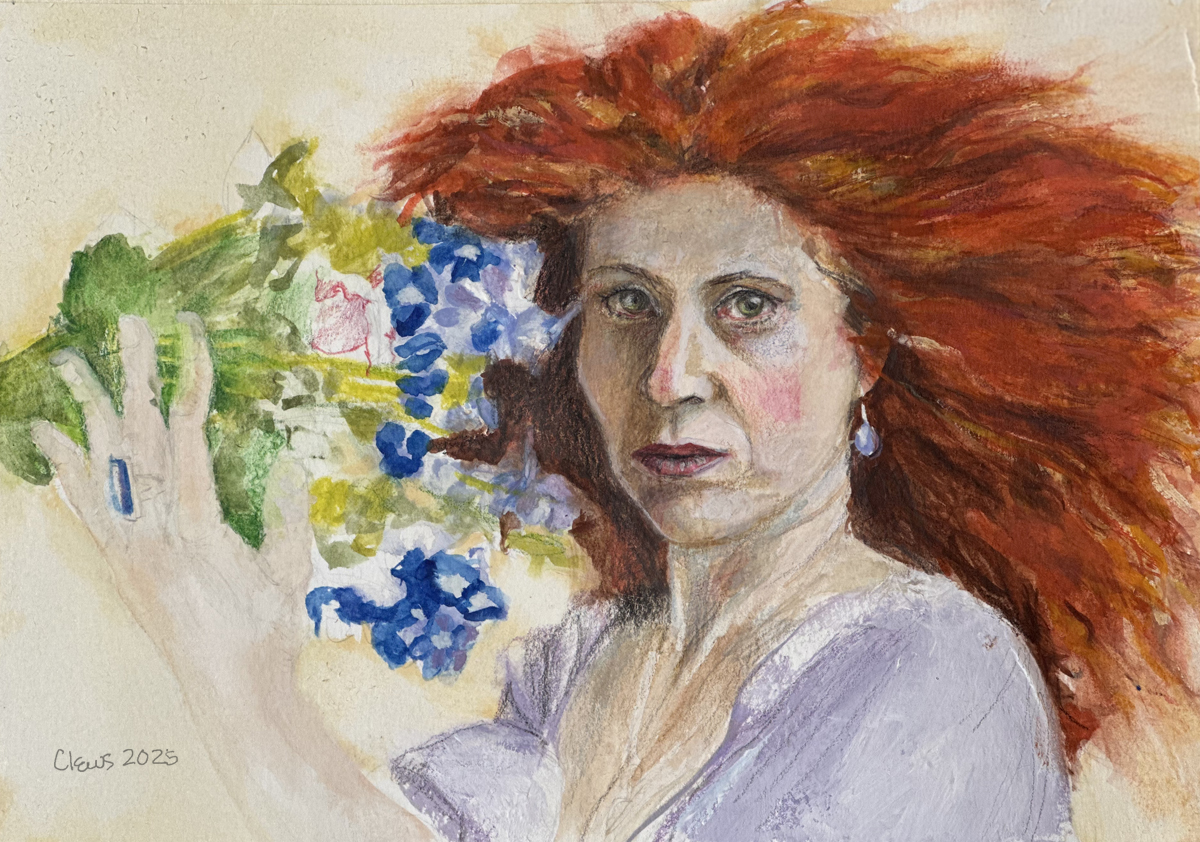
RUBIES IN CRYSTAL
Does language hover between my nerve endings and the world, or is language my skin itself?
Sheath of feeling. Words groping to touch air.
When two vowels go walking, the first one does the talking
%890 %UTC, %2006, %0:%Oct %Ze is a very tricky letter, I tell my young students. It's like the e of flea, and jumps clean over consonants and makes innocent vowels sitting there wake up and say their names. a becomes æ. At becomes ate. It's good, that letter e, but it can't jump over two or three consonants, so 'settle' remains 'settled.' And if e is next to c, watch out: e gets a crush, we could say. Then c gets stars in her eyes and forgets to be a 'k' and becomes a sinuous 's.' How do you read 'receives'? Of course, when two vowels go walking, one becomes shy, perhaps bashful, while the other proclaims its name.
Sometimes my young students can't read 'boat' or 'rain' or 'real' and so we jump up and walk around the room holding hands and I say, "We're a boat! I'll be a bashful 'a'; you be a courageous 'o' and say your name!" Are they puzzled? Maybe at first; then the laughter; then they start thinking up words we can play. If a parent looks in, I say, "It's okay! We're vowels marching around the dining room table!" They smile and withdraw politely.
Never mind the exceptions, I say - that's why we have memories: to memorize the exceptions!
I teach phonetically with flash cards that we make together as we travel into the wondrous land of reading. I teach differently to the regular school system of expecting children to 'pick up' reading from a reading-rich environment. Often my students simply memorize stories that have been read to them and are unable to recognize words out of that context. Teaching them phonetically gives them a way in to reading anything anytime. When my little students get tired or on 'overload' before our weekly hour is up, I'll switch roles: "Okay, time for you to teach me!" And I read so badly and make so many mistakes, but all so earnestly, they're laughing almost too hard to correct me, but correct me they do, my beautiful little charges.
My only motive, afterall, is to set them on a path of delight in the craziness of leaping e's, and vowel pairs who are friends, one out-going and one shy, ou's that are yowling, and the super shy silent h's that follow all the w's of every question word, as I hopefully open the world that a love of reading provides.
__________________________
(This little piece shows the barest surface of a phonetic-based reading system. And, yeah, their marks usually rise about 2 grade points; if they were getting D's, after a couple of months of the crazy Tuesday Tutor, we could expect B's; meaning, yeah, it's not just fun but they also learn actual reading skills that they get to keep after Ms. Tutor's a phonetically dim memory...)
Letter from a restaurant
%942 %UTC, %2006, %0:%Oct %ZI sit at a small table covered with clear plastic under which a string tablecloth, woven in a loose stitch with an orange central flower radiating out in a circular pattern that stands out from the white stitching, lies. Lifting the glass stopper on a bottle of olive oil, I pour a delicate gold stream over my mostly lettuce salad, and then, from the other bottle, fresh lime juice. When the glass of housewine arrives, it is slightly vinegary, and I wonder if they bottled it themselves. The beef Keba is tender, the white rice is intermixed with yellow orange grains cooked with saffron. On the edge of the oval dish is a stewed tomatoe.
The patrons consist of an older retired couple, two young men in suits talking about business, and two Indian families who sit at tables pulled together. My favourites are a girl and boy, both perhaps 18 months old, whose words consist of 'blaaah...' and 'ma-ma-ma.' I think they are told they are too noisy for the woman in the corner because I am pointed at and they both suddenly turn and look at me with wide brown eyes. I smile, they smile, and then they run around the tables until their mothers grab them and put them in the high chairs. The women each have long shiny dark hair and are young and beautiful and are dressed in new sweats, unlike their husbands in their starch white shirts and office trousers. Throughout the meal, they continue to expend energy tying to quieten the children while their husbands talk. I think of an always-smiling young Parsee woman I met at a job recently and her wedding that week in a dress of white lace; afterwards, she said, she was changing into a mustard honey sari with gold threads sewn through it, the colours of the table cloth and the fragrant rice before me. I wonder about the Parsees in India; my young soon-to-be married friend originally from Sri Lanka, and if the life ahead of her will be similar to the families seated near me.
The young children cannot sit still in silence. I ruminate on what I am observing, mon cher. Why do we feel we have to contain energies that are different to our own? Why do we need to bring others down to our level? Why do we try to silence each other in the ways that we do?
These are questions that are haunting me, as you know, Monsieur.
I watch the fathers' irritation with the noisy children; the mothers' attempts to stop them from crying. What is this process of containing that begins so young?
The waiter, who can barely keep up with the orders, and runs from table to table, and the man behind the counter, who is also the cook, look like brothers. They have just opened this restaurant, on borrowed money perhaps. Business is already going well.
Inflamed
%604 %UTC, %2006, %0:%Oct %ZI wanted to post the poem, not talk about the bad night, and enjoy my quiet weekend making my way out into the day today, but I'm aching, light-headed, still swimming in the depths of the emotional disaster last week, the emailing, the words, the decisions, the silences, the loss.
Incomprehensible on the edge of.
Aren't they all edges?
And where is.
A Blog Recommendation
%472 %UTC, %2006, %0:%Sep %ZIra Socol, whose work I've been reading for over two years now, is one of the best writers I've found who is posting on the NET. Stylistically, his work is nearly perfect and continually astounds me. He manages, through action, memory, description to convey complex situations and characters. One doesn't get a sense of judgment of the characters in these often complex situations by the narrator of the piece, nor any of the self-aggrandizing or moralizing that is rife in the blogosphere, only compassion. He writes perhaps a kind of 'film noir' prose and his writing, without a word of excess, seems always to overflow into poetry. Despite posting rough drafts for a book, his posts are encapsulated and complete in themselves - knowing the broader sweep helps, but it's not necessary.
While it is wonderful of him to include my blog among his 'most read,' his site is one of the best in the blogosphere and I would highly recommend it to anyone.
Writings of 'Who'
%529 %UTC, %2006, %0:%Sep %ZFellini's "La Dolce Vita"
%796 %UTC, %2006, %0:%Sep %ZWe should learn to love each other so much we live outside time ... detached.
He said (Steiner). La Dolce Vita (1960).
Who can love in a world where money must be made? The film is from a man's perspective. It is the women who talk of love; if love is spoken of. Especially Marcello's fierce, suicidal and beautiful girlfriend for whom love is possessive.
Those whose lives overflow with money don't know what to do with love either. Fellini knows this. Love wants to hold, to keep forever in its embrace, but it's all feathers. The clouds of pillows become unstuffed. We are tarred with our desires. What we are searching for are endings.
(Or so Fellini implies, not I.)
(from a mss-in-progress)
Andy Warhol / Supernova
%510 %UTC, %2006, %0:%Sep %ZThe eye that doesn't weep, the unblinking eye is a dangerous eye. Warhol made it art, though, and so gave it an entrance into the pathos of living, and thus an ethos. The unblinking eye doesn't have an ethic. Perhaps only the eye that weeps does. And do we find ourselves weeping before the accident victims who he emblazoned from newspaper images into wall-sized silkscreen repetitive images that fade out? Who are these anonymous dead people, are they the future of us?
The film of the man sleeping was nearly unbearable. It was Edgar Allen Poe's tell-tale heart, beating. The camera is angled on his chest and part of his face. We see his diaphragm move up and down with his breath, which is not always even, depending on his inner state, his dreams, and we see his chest pounding with his heart beat. That heart beat eventually pounds in our ears. It is visceral, the core of the pulse, the central ventricle, where the blood gushes in and out of, hundreds of litres an hour. We find ourselves dreaming with the man who's sleeping and whose heart we witness beneath his chest with the black hairs that we can almost feel under our fingertips. We become voyeurs, watching the minutiae of the vulnerability of sleep.
Warhol was a voyeur, no doubt about it. He chose moments in the continuum of images to still, to repeat spatially. Moments that compose us in a moment in time, a moment in history.
If I seek to integrate the critic with the poet, Warhol did not help in that quest. When we arrived, my friend and I, we were given a large black phone with numbers to press. Then we heard recordings, Cronenburg, actors, critics, memories of those who knew him, visited his studio, were part of his crowd or had a portrait done by him. The rooms at the AGO devoted to the show held people standing before large silkscreens or screens of moving images with a big black phone to their ears. It was eery. We were in a wired world that he perhaps prophesied. But we could not fully 'read' Warhol without the 'critical' accompaniment.
Warhol impartially recorded the effects of passion: the most wanted criminals; photographs of horrendous accidents, suicides; and sex, a man's face only while he receives a blow job; and the terror of narcissism as the 3 minute film records an unmoving, unblinking subject who dissembles before it, showing the stark soul in the unwavering eyes and the retreat into blinking, self-consciousness, an attempt to veil while being instructed not to before the artist left the room. As he impartially took snap-shots in the recording of us, in stance perhaps like Joyce's Portrait of the Artist, 'paring his fingernails,' Warhol was, for me, cerebral. You cannot view his work without knowledge of its background, what he was doing, how it came about, what it means, its critical context; without this information, you are lost. Everything is a 'found image.' Nothing is original. It is the unblinking eye, a constant surveillance, even if Warhol's "eye" is a configured eye and pointed like a spotlight. His work is a comment on culture, almost a footnote on it, and we need to be guided through the specifics of that culture was before we can begin to understand it. Warhol has not become fetishized by our culture, become a cliche, though shows like this may help, as well as productions like the 4-hour PBS documentary, to the point where we fully understand the message of his medium without explanation.
tags: Andy Warhol, Andy Warhol: Supernova: Stars, Deaths and Disaster, 1962-1964, Art Gallery of Ontario.
Visiting "Andy" Today
%458 %UTC, %2006, %0:%Sep %ZToday I expect the collusion of the critical and the poetic to be further clarified. I'm going to the Andy Warhol show at the Art Gallery of Ontario which should be interesting - I find his work, despite its elevation of the commercial icon to art, cerebral. It requires a critic as go-between, as intercessor, a body of theory to explain it. Commercialism figures highly in Warhol's art. He was a successful commercial artist before becoming a 'fine artist,' and he became hugely successful at that, too. He took cultural icons, Marilyn Monroe, Jackie Kennedy/Onassis, and made us aware of our deifying tendencies. Or elevated the ordinary to the status of high art, like a show of packing boxes, filming the Empire State Building for 8 hours, filming a man sleeping through the night... I had no use for Warhol's aesthetic or artistic mentality when I was an art student many years ago, he never 'spoke' to me on any level about the possibilities of art. He was the showman showing the showmanship of our society. But then as now, I'm not a conceptual artist. Thanks to this show, though, I am already revisiting my biases and am beginning to even think he was a prophet - of the internet/media driven world that we live in, and that puts him in a whole other category. I may even end up liking him.
I'll let you know.
(Here's a link to an article, Andy Warhol's Smirking Genius, on the PBS 4-hour documentary on Warhol.)
On the Life of an Artist
%572 %UTC, %2006, %0:%Sep %Z"Wallace Stegner, an author who served as director of the Creative Writing Center at Stanford ... [wrote an] essay "To a Young Writer" (November 1959) [that] took the form of a letter addressed to a former student—a twenty-something young woman with literary aspirations, a graduate degree, and an unpublished novel. Stegner sought at once encourage her and to give her an honest picture of how difficult her career path would be.
He began by expressing empathy for the uncertainty she must now be feeling:
To date, from all your writing, you have made perhaps five hundred dollars for two short stories and a travel article. To finance school and to write your novel you have lived meagerly with little encouragement and have risked the disapproval of your family, who have understandably said, "Here is this girl nearly thirty years old now, unmarried, without a job or a profession, still mooning away at her writing as if life were forever. Here goes her life through her fingers while she sits in cold rooms and grows stoop-shouldered over a typewriter." So now, with your book finally in hand, you want desperately to have some harvest: a few good reviews, some critical attention, encouragement, royalties enough to let you live and go on writing...
You would like to be told that you are good and that all this difficulty and struggle and frustration will give way gradually or suddenly, preferably suddenly, to security, fame, confidence, the conviction of having worked well and faithfully to a good end and become someone important to the world.Stegner warned, however, that fame, fortune, and accolades would most likely not be forthcoming. Not because her work was not good: "You write better than hundreds of people with established literary reputations.” The problem, he explained, was that her writing was aimed over the heads of the mass of readers, and would therefore only ever be appreciated by a small audience of "thoughtful readers." She would thus always find herself struggling—"pinched for money, for time, for a place to work."
So was all this worth it? "I would not blame you,” he wrote, “if you ... asked, Why spend ten years in an apprenticeship to fiction only to discover that this society so little values what you do that it won't pay you a living wage for it?"
But in the end, he argued, living to practice an art that one does well is its own reward:
For you ... it will have to be art. You have nothing to gain and nothing to give except as you distill and purify ephemeral experience into quiet, searching, touching little stories ... and so give your uncommon readers a chance to join you in the solidarity of pain and love and the vision of human possibility.
But isn't it enough? For lack of the full heart's desire, won't it serve?"
I think you have to just not care about what people think of you while you scribble away. Future fame or fortune are irrelevant. You do it while your family and friends shake their heads and wonder why with all that education and ability you seem to be doing nothing, and they pity you and shake their heads and you have to just let them. There is no teleology to it; simply, you have to release yourself of the books that want to be born. You labour alone, that's just the way it is. No point fighting it. Without "a product," a society based on capitalism, commercialism has no way to gage value. Until the book is written and published, there is no "product," and, therefore, no "value."
Though I don't know about you, personally I haven't found that giving up and walking away from one's muse is an option. Exigencies of the muse, though, is another topic.
Today I Am Not Good with Words (Ver.3: switching to the epistolatory form)
%939 %UTC, %2006, %0:%Sep %ZI confide in you, Monsieur, troubled by the writing we are immersed in. The air is steamy, damp. And the communities, internet colonies, are like flocks of birds flying in scattered formations. Today, mon cher, I am not good with words. I say what people already know.
You ask me to describe her? I trace patterns of words to read the braille she is. It is like surfing where the screen becomes a crystal ball of tides. Posts open and close like visions. Writing hides in an ocean continually closing over itself.
Her stories are long, drawn out, each paragraph a wave dissolving the sand, the shore, encroaching. She is the rising tide; it is overwhelming. My computer screen is splashed with spilling breakers.
Must I imagine her? Like seaweed, hair, dark, long, pulled back loosely with wisps softening around the face, I think. I've never seen her; shall never gaze upon a photograph. She wears only veils of words, an obscuring sea spray of a forcefulness that surprises.
While I want to stay in the imagery of water, Monsieur, the metaphors shift. Let us leave the desolate shore and come into the city of words. Where her house is and where she moves like an exotic figment, a flash of fabric and skin.
A blackness of cloth, surely, but not without red. Brooch of a poppy. Toss of bead earrings, like Native American dream catchers. Or that ruby rising out of a ring of melted, cast sun, the only one on her hands woven with pale veins and the delicacy of a musician's fingers. Open her closet and you will find on the floor red canvas tennis shoes, ginger petal satin Chinese slippers, patent leather ruby heels, flaming red slick knee-high boots. On the shelf, a vinyl orange belt, crimson silk sash, red opera gloves, a vermilion felt hat. Dragging down the white wall like Barnett Newman's "Lema sabachthani" series, a funerary dirge of black dresses, a heavy curtain of silk, cotton, corduroy, rayon, wool hung on cedar-scented hangers.
Her writing spills out of its unkempt garden, overflows with the redness of a sensuality that is both innocent and over-ripe, tended and unweeded. It is like Oscar Wilde's "Salome"; if she who holds the platter on which the prophet's head rests was a writer. Or Beardsley's version in black lines, but aged: white skin, black habit, and the blood red splashes that are uniquely hers. I smell perfumes and compost: perhaps her writing resembles a mass of cut flowers in varying stages, some dying, some bursting forth; floral, with dark passion.
But always the salt swirling about. It leeches the soil. Dying follows her. She's in a difficult economic situation, desperate really. How she came to penury is a tale that grows more strange in each telling. The publications for which she wrote were autumnal leaves that fell and floated away. Her fish bones were broken and reset crookedly. Yet she fishes, and scales mercilessly what's caught. Is she a victim? Or a perpetrator? I don't know.
One doesn't know the true story or if there are any true stories.
An onrush of waves now, from the sky, from the ocean, it doesn't matter. Salt water in my mouth. Monsieur, I beseech you, help me break free of the undertow. Why does she silence us - I, and the others? She speaks in the diminutive. Sarcasm of a sea-side parrot, words twisted in the ruffle of virid and cinnabar feathers, inside the sharp beak. Have I found someone to beleaguer my laboured writing? It becomes unbearable, the denouncer's voice. Do I imagine a fertile slope for my Sisyphean ball of letters instead of an ocean of caustic words? Why can't I turn and go elsewhere, where welcomes wait?
Monsieur.
Your beloved.
Jul 2026
Apr 2025
Feb 2025
Jun 2024
Apr 2024
Aug 2023
Oct 2022
May 2022
Oct 2021
Sep 2021
Jul 2021
May 2021
Jan 2021
Oct 2020
Aug 2020
Jul 2020
Jun 2020
May 2020
Dec 2019
Sep 2019
Aug 2019
Jul 2019
May 2019
Apr 2019
Feb 2019
Jan 2019
Nov 2018
Sep 2018
Aug 2018
Jul 2018
May 2018
Apr 2018
Mar 2018
Feb 2018
Jan 2018
Dec 2017
Nov 2017
Oct 2017
Sep 2017
Aug 2017
Jul 2017
Jun 2017
May 2017
Apr 2017
Mar 2017
Feb 2017
Jan 2017
Dec 2016
Nov 2016
Oct 2016
Sep 2016
Aug 2016
Jul 2016
Jun 2016
May 2016
Apr 2016
Mar 2016
Feb 2016
Jan 2016
Dec 2015
Nov 2015
Oct 2015
Sep 2015
Aug 2015
Jul 2015
Jun 2015
May 2015
Apr 2015
Mar 2015
Feb 2015
Jan 2015
Dec 2014
Nov 2014
Oct 2014
Sep 2014
Aug 2014
Jul 2014
Jun 2014
May 2014
Apr 2014
Mar 2014
Feb 2014
Jan 2014
Dec 2013
Nov 2013
Oct 2013
Sep 2013
Aug 2013
Jul 2013
Jun 2013
May 2013
Apr 2013
Mar 2013
Feb 2013
Jan 2013
Dec 2012
Nov 2012
Oct 2012
Sep 2012
Aug 2012
Jul 2012
Jun 2012
May 2012
Apr 2012
Mar 2012
Feb 2012
Jan 2012
Dec 2011
Nov 2011
Oct 2011
Sep 2011
Aug 2011
Jul 2011
Jun 2011
May 2011
Apr 2011
Mar 2011
Feb 2011
Jan 2011
Dec 2010
Nov 2010
Oct 2010
Sep 2010
Aug 2010
Jul 2010
Jun 2010
May 2010
Apr 2010
Mar 2010
Feb 2010
Jan 2010
Dec 2009
Nov 2009
Oct 2009
Sep 2009
Aug 2009
Jul 2009
Jun 2009
May 2009
Apr 2009
Mar 2009
Feb 2009
Jan 2009
Dec 2008
Nov 2008
Oct 2008
Sep 2008
Aug 2008
Jul 2008
Jun 2008
May 2008
Apr 2008
Mar 2008
Feb 2008
Jan 2008
Dec 2007
Nov 2007
Oct 2007
Sep 2007
Aug 2007
Jul 2007
Jun 2007
May 2007
Apr 2007
Mar 2007
Feb 2007
Jan 2007
Dec 2006
Nov 2006
Oct 2006
Sep 2006
Aug 2006
Jul 2006
Jun 2006
May 2006
Apr 2006
Mar 2006
Feb 2006
Jan 2006
Dec 2005
Nov 2005
Oct 2005
Sep 2005
Aug 2005
Jul 2005
Jun 2005
May 2005
Apr 2005
Mar 2005
Feb 2005
Jan 2005
Sep 2004
Jun 2004
May 2004
Oct 2003