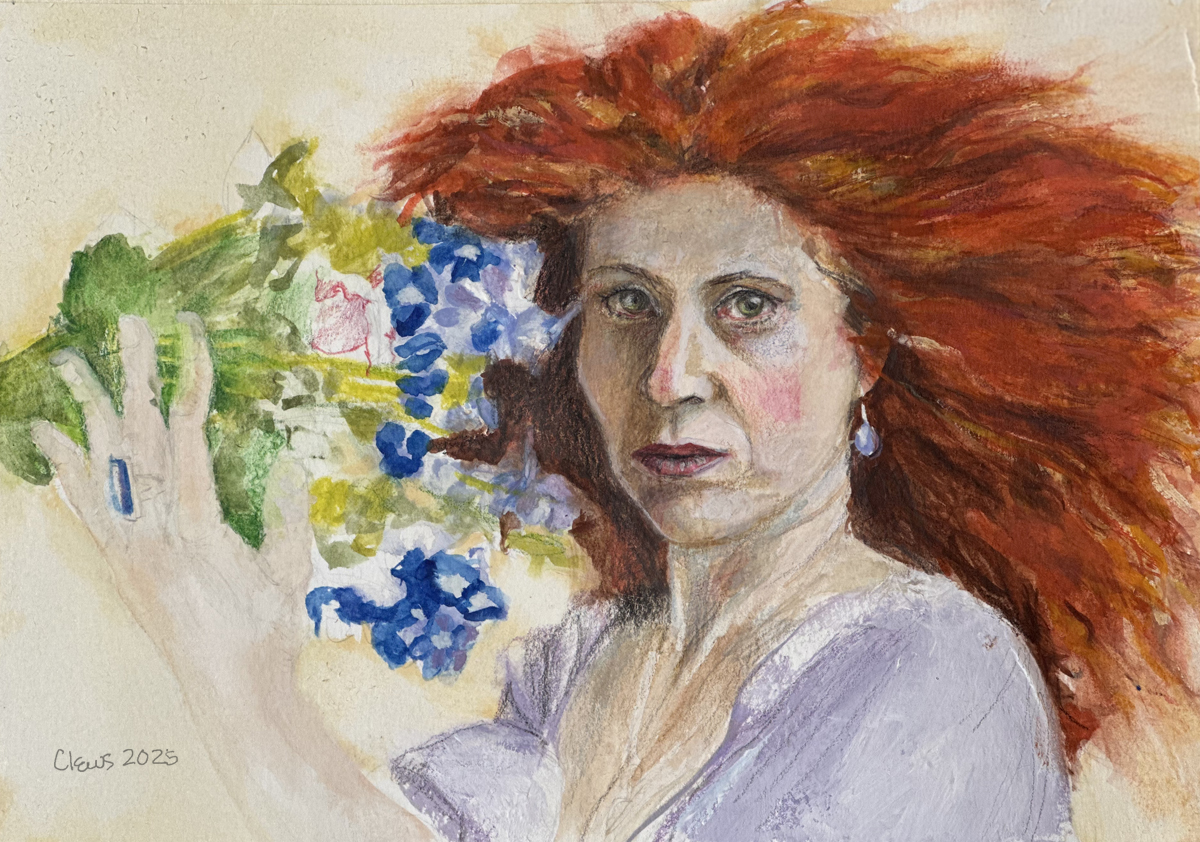
RUBIES IN CRYSTAL
Does language hover between my nerve endings and the world, or is language my skin itself?
Sheath of feeling. Words groping to touch air.
Mount Merapi
%591 %UTC, %2006, %0:%May %Z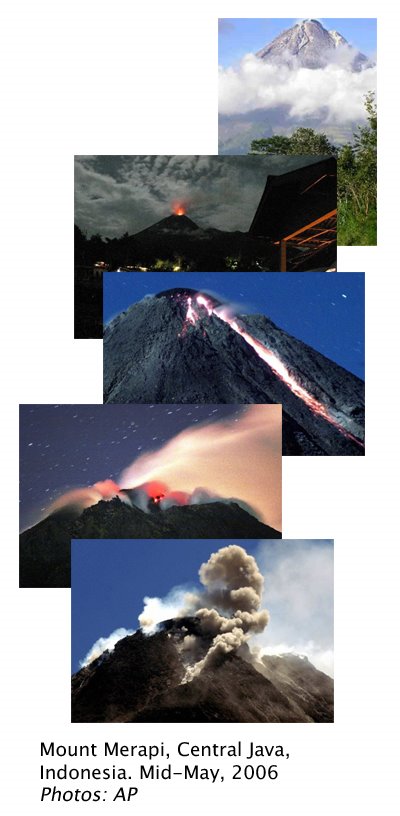
Can't we see why the ancients thought that a hell existed beneath the earth of fire and brimstone?
An angry underworld war lord belching flames for the unworthy.
Explosions of acrid smoke, flames shoot into the sky, darkness spreads over the land, rivers of redhot lava overflow, burning down the mountainside, searing villages, the world is ignited.
The heat cloud is growing, but, as of Monday morning, Merapi hasn't blown yet. Evacuations continue. Here's a news report.
 They will come in the car. They will stop to pick you up. When you get into the car, they will be silent. There may be tears on their cheeks. They will let you know the barest facts. You must understand that they are numb, with shock, sadness, grief, anger. Perhaps there will be talk of logistics, how and when. These are the simple things, where we feel useful. You will sit in the car while it is driven the distance. If he is driving, his knuckles will be taut, white, on the steering wheel. He is already writing in his head what is happening, composing the elegy. He cannot fathom the split in his heart. This time it's real in a way that it never has been before. The one who I urge you to care for sits beside you, looks striken out on the grey highway, uncomprehending. The trip will be wordless. When they arrive home, they will all disappear, into other parts of the house, into their rooms, into the silence of their hearts, to wail, to struggle, to feel the deep heaving. My love is with you, know this.
An Hour at Christie Pits Park in the Late Afternoon
%687 %UTC, %2006, %0:%May %ZYesterday's word sketch. I wished I'd had my camera with me, or more time to do a drawing. Today it's raining, natch.
I sat on a hill and wrote, in celebration of Spring, what I could see from my vantage point:
Green curve of hills, painted leaves across the sky, blowing, graceful. Soccer in the far field, the white ball rolling, figures in shorts running, kicking, the ball flying high. A row of young trees with pale green leaves beside the path of sand and pebbles that swings around the baseball diamond where a small group of men and women prepare for a game. Two black dogs chase balls their owners throw; the dogs aren't perfect retrievers and require pointing and verbal gesticulating. A group of young men, students perhaps, play an informal game of soccer on the grass nearby and I see the circular black patterns on the ball as it flies from foot to foot. Children are climbing and swinging and shouting in the playground in the distance as they do year after year. I sit in my baggiest comfortable jeans in a collapsible camping chair on a green heaving hill of birdsong watching my sociable dog romp between the other dog people and small groups lounging nearby before tearing up the hill and into the brush. The hill is already deep green with thick grass and a shawl of dandelions, yellow dancing soft pompoms, fluffy tufts, or empty waving stalks. There is an unending medley of voices, men's, women's, children's, the thud of the soccer ball, a baseball bat hitting the leather ball, the dim revving of small packs of traffic behind me, flowing according to traffic light patterns, a drone of distant planes in the sky and the whir of a traffic helicopter like a large dragon fly. It is Spring; the world has awakened and come out to play...
Back, and back on track
%814 %UTC, %2006, %0:%May %ZMy daughter's been intensively working on a school project on our currently "one" computer - the iMac, which has never crashed nor come down with any viruses, and I managed to slip in to say hi. There was an excellent response to my two presentations, which is all leaving me wondering, once again, if I really do belong in academia. Oh, sigh...
Do you have an iconography of intuitive images?
%443 %UTC, %2006, %0:%May %Z'Lizard Man' is a little differently configured. A new twist. Something less human and more reptilian; less amenable to reason or understanding. He was also 'inside' rather than looking at the dwelling from 'outside.'
Do I believe in magic? Magical consciousness is one thing; magical thinking is another. An image like this, however, lends itself easily to magic. So I can throw unsplit prisms of white light around our little home. I can surround the figure in fury and banish him to the eternal nether-worlds. I can write about him in my blog and so exorcise him.
Or, like Mary says, I can lay out the welcome mat and invite him in to do his lizard thing.
It would be funny if it wasn't so serious.
Perhaps I hope by writing to break any causal chain, or any link between intention and action.
Now that's magical thinking. But, hey, magical images got me here in the first place, so they gotta help me get out of a place of potential danger too. :)
Patry, moving would be the solution, and that's what we most would like to do.
Thank you Sky- bars on the windows would help, but then we'd be sentencing ourselves to suffocation if there was a fire. The motion of our dog would set off any security system. But, hey, our dog is a security system herself! She wouldn't like 'Lizard Man,' I know she wouldn't. :)
Mary, yes, responding in an opposite way to what would be expected might turn the chain of intentions and actions awry. And, anyway, doesn't gnosis only occur because of transgression?
Jean, really and truly it's getting worse. Too many images crowd in these days. If they're negative in any way, they happen; likewise if they're positive. I'm not sure what that is, but I tremble before it, and try to maintain a consciousness of love, clarity, freedom, purity. Daily struggle, of course... :) Meditation helps.
My intuitive imagination has a iconography of images that apparently correlate to oncoming events... sometime I should do a post on them. As I get older I get better at reading the signs.
How about you?
The 'Lizard Man.' What do we do with our intuitions?
%392 %UTC, %2006, %0:%May %ZI saw a similar 'Gargoyle Man' standing in the back yard staring at our house in Vancouver. A few weeks later the house was broken into when my kids were home and I was at work. It was very stressful.
Not much was taken either time. The images of the 'Gargoyle Men' preceded the break-ins both times. The men in the images were boyish, Pan-like, mischievous, but not harmful. As with any break-in, though, I felt marked, violated. The burglars had been considering, watching.
This morning in that half-light, coming out of the wells of the light of my dreams, I saw, not a 'Gargoyle Man,' but a 'Lizard Man.' The same fixated stare at where I live. The same greenish colour. Only his body was actually a lizard's. We live in a basement, and there is a small array of insects down here that you'd find any place you lived close to nature (or the earth, as we are). So this 'Lizard Man' is somehow associated with that: the occasional potato bugs, ants, spiders. Something reptilian. Or I would assume. And less human than the 'Gargoyle Men.' Of course I'm worried!
Based on my previous intuitions, and this one was as strong, I'd say I'm due for another break-in. What I want to know is how to prevent what I see coming.
Having strong intuitions is one thing, knowing what to do is another. When I 'see' something like this it's like an archytypal 'stage set'; I can flit about, looking at the scene from many angles, but am powerless to enter it and change its script.
Each of the times it happened before, I couldn't. As the 'Gargoyle Men' were unaffected by my imaginal presence, so I didn't figure in the actual break-ins. But when you receive a 'warning' there must be some way to offset the possible series of actions that is about to take place?
I never took the 'visions' of the 'Gargoyle Men' seriously, and they had a connection to real life. Perhaps by writing about one of these images, it will change the outcome? If we live in a Quantum Mechanical world, that is.
What does a 'Lizard Man' mean?
untitled love poem (see comments, suggestions welcome)
%351 %UTC, %2006, %0:%Apr %ZYou rise out of flat stone
the shield
of your heart.
The moon crosses the sun.
Do we
become light
when we dream?
The folds of your corduroy
like ridges and hollows
furrows where the Spring runoff
sculpts a geology
in a landscape of tundra.
In our Klondike, cross and beams
hold the tunnels we dig through
to find the gold in each other,
rich veins tracing through the rock
like sunlight.
II
Spring is a tendril
of green;
the leaves a papery mass of veins unfolding.
Cliffs of grass by the old mine ripple
in the wind.
We are like those two trees
ancient, weathered, yet
our roots thoroughly
intertwined.
What is
underground
is what holds us.
The deeper passageways
and connections.
III
I wear the crescent moon in my hair,
the cold northern air;
you are the sun buried in the land,
illumined from within.
The sharp edges
in each moment
bind us.
My Adoni, my Aholi,
even in this harsh typography
you are a landscape of love,
a cartography of desire.
©Brenda Clews 2006
Update on my life...
%004 %UTC, %2006, %0:%Apr %ZI just have to figure out housing, meaning more space, a lot more space than my daughter and I have at present, to move it all into in the next couple of months. Even if housing doesn't happen as soon as that, I'm still okay with the storage company and the monthly rental we agreed on (the original amount, not the $200./month they tacked on once my stuff got to their storage warehouse in Mississauga, a suburb of Toronto).
Do I feel a sense of relief? Not really. More like I'm putting my heavy turtle shell back on and moving slowly ahead. That I can't just 'leave,' 'exit,' 'start over,' but have to continue on. It'll be nice to get my books back; I've missed them. And my clothes, oh yes. And my paintings - I'm not used to such bare walls as I have here. The family photographs. A dining room table. Stereo and TV. Kilim carpets. My Salton espresso/cappucino machine. Ah. And my yoga mat. My whole alter. Large desks. And bed. It's all nice to consider. Not necessary, as I know now, but nice. The comfort of my 17 year old sectional Italian leather couch from the Art Shoppe. The whole panoply unfolds. And my kids are happy that I've decided to reverse the loss, prevent it from happening, and to land, to stay.
Not there quite yet, but I'll figure it out. Along with some magic. For it's always ultimately about magic, isn't it.
Alpha Beta of Scripts
%339 %UTC, %2006, %0:%Apr %ZOur natural landscapes lie behind our alphabetic typographies. The fonts of our language reflect the pure forms of nature:
Remarkably, the study has concluded that the letters we use can be viewed as a mirror of the features of the natural world, from trees and mountains to meandering streams and urban cityscapes.
The shapes of letters are not dictated by the ease of writing them, economy of pen strokes and so on, but their underlying familiarity and the ease of recognizing them. We use certain letters because our brains are particularly good at seeing them, even if our hands find it hard to write them down. In turn, we are good at seeing certain shapes because they reflect common facets of the natural world.
from: Alphabets are as simple as...
In Arabic I see deserts and mirages, genies, a spirit that is as boundless as the open sky, tents under hot sun and blown by sandstorms, lyrical dwellings sculpted out of baked, whitewashed sandstone; I see the sinewy motion of Middle Eastern belly dancers, the crowded markets of barterers. In Hebraic I see a nomadic people, Hanukkah candles, the flame of an inner deified light. Chinese pictographs are as beautiful and intricate as the detailed landscapes of China, and in them I see also pagodas and monuments; they reveal a complexity of thought that I can only marvel at. If our letters mimic plains, mountains, streams, trees, branches, rocks and are shaped by our natural landscapes, our architecture is most certainly a gesture of the typographies of our alphabets.
We are drawing our world when we write.
Our architectures are our calligraphies writ large.
Meaningful marks on the page, jottings limning our natural environments, our sensory apparatus' translating our world into symbols that we can think through.


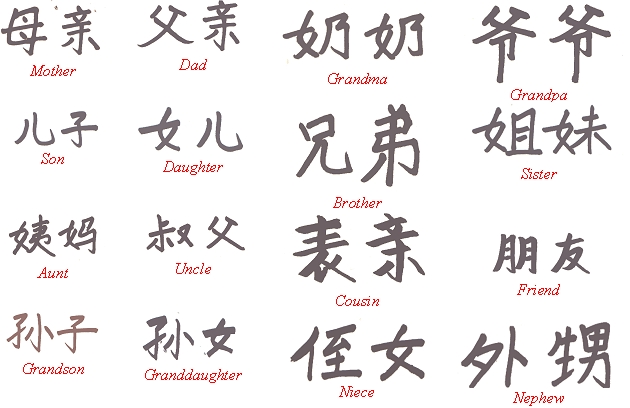

Chinese (Mandarin) pictograms and pagodas
(images courtesy of Google :)Dancing Clock
%790 %UTC, %2006, %0:%Apr %Z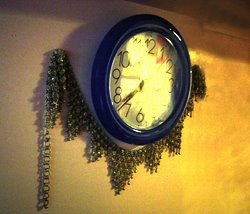 This inexpensive but clear clock gets a hammock of intricate interlacing metal filligree to tick in. The belly dancing belt that I bought at Dancing Days in Kensington Market has a place to hang.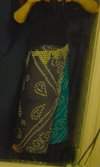
And the next time I dance to the earthy sounds of African drumming, I can become a tambourine and jingle can't I.

Jul 2026
Apr 2025
Feb 2025
Jun 2024
Apr 2024
Aug 2023
Oct 2022
May 2022
Oct 2021
Sep 2021
Jul 2021
May 2021
Jan 2021
Oct 2020
Aug 2020
Jul 2020
Jun 2020
May 2020
Dec 2019
Sep 2019
Aug 2019
Jul 2019
May 2019
Apr 2019
Feb 2019
Jan 2019
Nov 2018
Sep 2018
Aug 2018
Jul 2018
May 2018
Apr 2018
Mar 2018
Feb 2018
Jan 2018
Dec 2017
Nov 2017
Oct 2017
Sep 2017
Aug 2017
Jul 2017
Jun 2017
May 2017
Apr 2017
Mar 2017
Feb 2017
Jan 2017
Dec 2016
Nov 2016
Oct 2016
Sep 2016
Aug 2016
Jul 2016
Jun 2016
May 2016
Apr 2016
Mar 2016
Feb 2016
Jan 2016
Dec 2015
Nov 2015
Oct 2015
Sep 2015
Aug 2015
Jul 2015
Jun 2015
May 2015
Apr 2015
Mar 2015
Feb 2015
Jan 2015
Dec 2014
Nov 2014
Oct 2014
Sep 2014
Aug 2014
Jul 2014
Jun 2014
May 2014
Apr 2014
Mar 2014
Feb 2014
Jan 2014
Dec 2013
Nov 2013
Oct 2013
Sep 2013
Aug 2013
Jul 2013
Jun 2013
May 2013
Apr 2013
Mar 2013
Feb 2013
Jan 2013
Dec 2012
Nov 2012
Oct 2012
Sep 2012
Aug 2012
Jul 2012
Jun 2012
May 2012
Apr 2012
Mar 2012
Feb 2012
Jan 2012
Dec 2011
Nov 2011
Oct 2011
Sep 2011
Aug 2011
Jul 2011
Jun 2011
May 2011
Apr 2011
Mar 2011
Feb 2011
Jan 2011
Dec 2010
Nov 2010
Oct 2010
Sep 2010
Aug 2010
Jul 2010
Jun 2010
May 2010
Apr 2010
Mar 2010
Feb 2010
Jan 2010
Dec 2009
Nov 2009
Oct 2009
Sep 2009
Aug 2009
Jul 2009
Jun 2009
May 2009
Apr 2009
Mar 2009
Feb 2009
Jan 2009
Dec 2008
Nov 2008
Oct 2008
Sep 2008
Aug 2008
Jul 2008
Jun 2008
May 2008
Apr 2008
Mar 2008
Feb 2008
Jan 2008
Dec 2007
Nov 2007
Oct 2007
Sep 2007
Aug 2007
Jul 2007
Jun 2007
May 2007
Apr 2007
Mar 2007
Feb 2007
Jan 2007
Dec 2006
Nov 2006
Oct 2006
Sep 2006
Aug 2006
Jul 2006
Jun 2006
May 2006
Apr 2006
Mar 2006
Feb 2006
Jan 2006
Dec 2005
Nov 2005
Oct 2005
Sep 2005
Aug 2005
Jul 2005
Jun 2005
May 2005
Apr 2005
Mar 2005
Feb 2005
Jan 2005
Sep 2004
Jun 2004
May 2004
Oct 2003