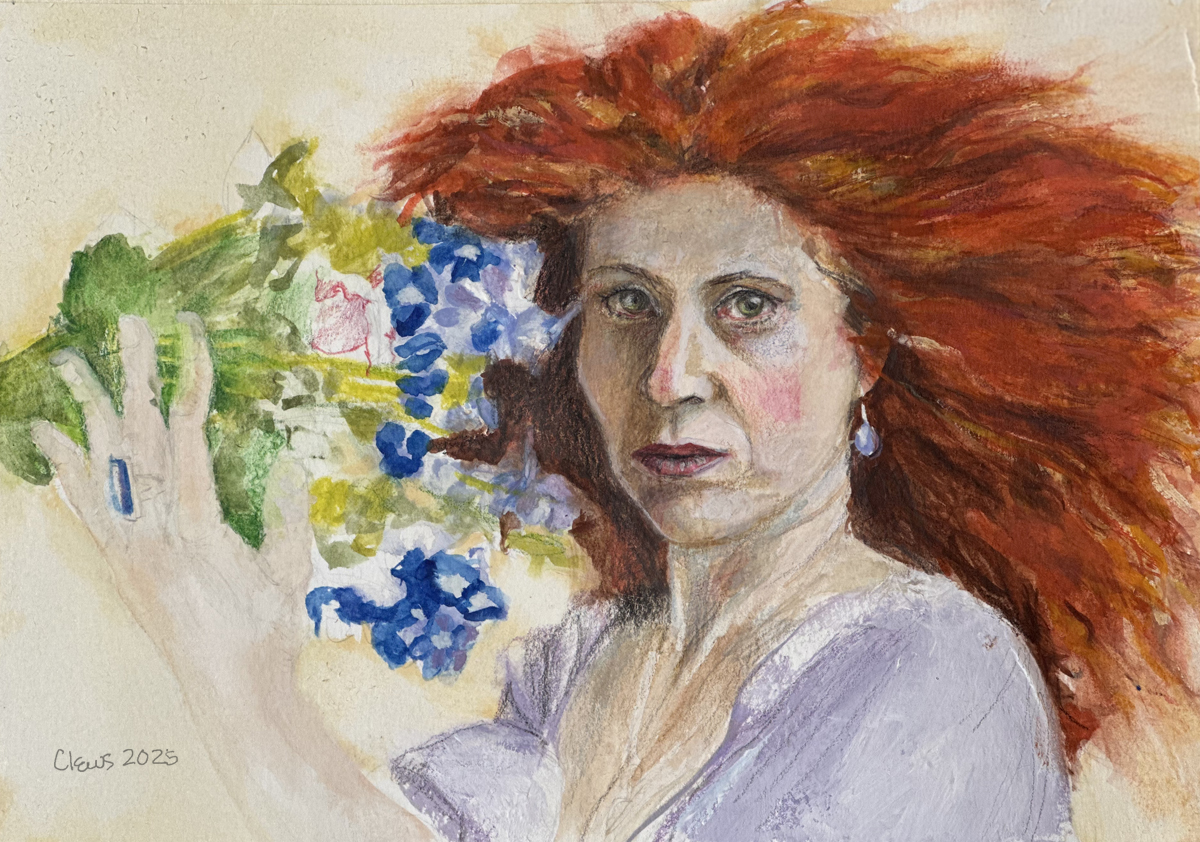
RUBIES IN CRYSTAL
Does language hover between my nerve endings and the world, or is language my skin itself?
Sheath of feeling. Words groping to touch air.
How do we think.
%693 %UTC, %2006, %0:%Feb %ZDo we know how to think? That's not as crazy a question as it seems. It started this morning with my wondering why we become entrapped in stories that we take to be reality. Like the Bible, or Koran, or the Tao te Ching, or the Mahabharata. These books are holy books, yes, and at the core of their culture's belief systems, but they are only stories. Stories that tell us how about the meaning of the world, how to act in it, and how to think. Because our thoughts are where we are most puzzled. The rest is easy, eating, sleeping, making love, working. Yet our thoughts affect our day-to-day reality and shape who we are and what we do. They are crucially important to our self-identities. Our thoughts compose us and compose our view of the world around us. But the ability to do this is a relatively new creation, entirely dependent on a 2mm layer on top of the cerebral hemispheres, the neopallium (Latin for "new mantle"), or neocortext as it is more commonly called, only about 200 million years old. This tiny layer, which is wrinkled into deep grooves in humans, thus packing in the neouronal columns, composed of some 10 billion neurons, is responsible for "sensory perception, generation of motor commands, spatial reasoning, and in humans, language and conscious thought."
It is the language and conscious thought part that I am musing on. It seems to me that our thoughts are a giddy, wild place, composed of giddy, wild language bits, and that, to tame the inner riots, we create stories that tell us how to think. Because we don't know on our own. We are all busy searching for 'states of consciousness' that will enable us to exist peacefully with the rampant energies of the synaptic connections in our modern brains. Afterall, we're not just thinkers, but conscious of our thinking. And being 'self-conscious' is one of the most difficult states to be in.
Is that why we believe the powerful stories of our culture? Why we take them to be accurate versions of the truth? Because it settles our thoughts, having a specific set of ideas to work with, a certain way to think?
This post is only about some questions I had preparing an omlette for my son, who is visiting for a few days.
Did the omellete curve and bellow like a neopallium? I can't say, but perhaps.
It is the language and conscious thought part that I am musing on. It seems to me that our thoughts are a giddy, wild place, composed of giddy, wild language bits, and that, to tame the inner riots, we create stories that tell us how to think. Because we don't know on our own. We are all busy searching for 'states of consciousness' that will enable us to exist peacefully with the rampant energies of the synaptic connections in our modern brains. Afterall, we're not just thinkers, but conscious of our thinking. And being 'self-conscious' is one of the most difficult states to be in.
Is that why we believe the powerful stories of our culture? Why we take them to be accurate versions of the truth? Because it settles our thoughts, having a specific set of ideas to work with, a certain way to think?
This post is only about some questions I had preparing an omlette for my son, who is visiting for a few days.
Did the omellete curve and bellow like a neopallium? I can't say, but perhaps.
Comments (17)
Falling... a story about nothing.
%566 %UTC, %2006, %0:%Feb %ZUsually denying myself food and drink after 6pm because I don't sleep well and if I wake to go to the bathroom in the night, I'm awake for hours. Do I remember that my blood pressure is on the low side, and plummets if I'm dehydrated or hungry? Which I am every morning as I rise, make coffee, let our dog out, wake my daughter.
Walking into her darkened room in my long dressing gown, I step on a winter boot, the hem of my dressing gown catching under my foot as it slides, caught on the mid-calf length faux sheepskin. The bog of materials pivots me. I can't rebalance myself, my foot trapped by the gown and the boot, neither relinquishing their hold. I'm lightheaded anyway. I fall straight back like an ironing board.
I try to bend in mid-air, to allow my rump to take what's coming, but can't manoever my body. I fall onto soft carpet, inches away from a wooden chair, on the back of my head, which I'm trying to tuck in for protection.
After impact, I roll on my side in a curled position and cry, oh so melodramatic but a way to release the shock of the fall. My daughter, who usually takes half an hour to wake up, leaps out of bed to hug me and help me up. I'm fine, feel no pain, didn't lose consciousness, no concussion.
The headache begins towards bedtime. I'd forgotten about falling but had spent a listless day of little substance feeling grey. Today it is like a fire simmering in my upper back, shoulders, back of my head. There is some minor bruising, that's all...
Walking into her darkened room in my long dressing gown, I step on a winter boot, the hem of my dressing gown catching under my foot as it slides, caught on the mid-calf length faux sheepskin. The bog of materials pivots me. I can't rebalance myself, my foot trapped by the gown and the boot, neither relinquishing their hold. I'm lightheaded anyway. I fall straight back like an ironing board.
I try to bend in mid-air, to allow my rump to take what's coming, but can't manoever my body. I fall onto soft carpet, inches away from a wooden chair, on the back of my head, which I'm trying to tuck in for protection.
After impact, I roll on my side in a curled position and cry, oh so melodramatic but a way to release the shock of the fall. My daughter, who usually takes half an hour to wake up, leaps out of bed to hug me and help me up. I'm fine, feel no pain, didn't lose consciousness, no concussion.
The headache begins towards bedtime. I'd forgotten about falling but had spent a listless day of little substance feeling grey. Today it is like a fire simmering in my upper back, shoulders, back of my head. There is some minor bruising, that's all...
Comments (7)
Canvas of light
%542 %UTC, %2006, %0:%Feb %ZClick on the photo to go to flikr to see the slideshow of the photographs my 15 year old daughter took of her 53 year old mother that night, or the sidebar of Rubies in Crystal for a flikr montage of photos ...
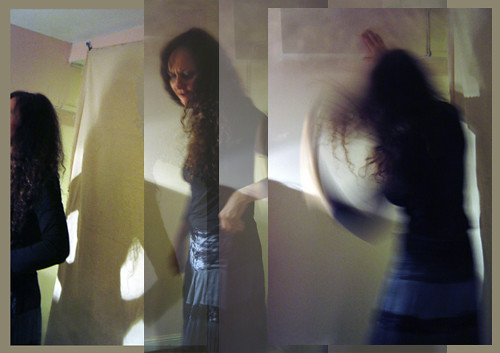
Moving across the canvas, shadows. In the lights once I counted five shadows, some short and close, others long and stretching far. Did that mean I existed? How do photons spin around us and collide into the wall leaving a dark imprint of our shape? Are our obscure lives the canvas that catches us? I dance through the hours of my days, sitting, walking, sleeping, eating, talking. Breath is a dance. Displacing the air, sending the light spinning around us, the impulse of our thoughts flinging ideas into being through our bodies. Is a dance. You at the computer screen with your dancing fingers on the keys playing music for me who reads you. A grammar of light flies off into incandescence, shadowing, spotlighting, a flux that captures us, moments burnt into negative space, where it's empty, in the vastness of dark energy between the luminescences. Give me a moment, this pensiveness, before I turn and gaze upon you, love.
(the "you" in all my pieces is always the reader, you, my unbidden, golden muse, without whom I would write nothing.)
(the "you" in all my pieces is always the reader, you, my unbidden, golden muse, without whom I would write nothing.)
Comments (8)
How a woman.
%898 %UTC, %2006, %0:%Feb %Z(Sat: With Blogger down again what was I to do but tinker with this? The first paragraph slightly revised (sorry to upload it again to those of you with feeds! Like the 9th time?)
Fri: How hilarious!- Blogger's been acting up this evening, giving error messages, refusing to open sites, and now that it's working again I discovered eight copies of this post! And 8 copies have been duly emailed to me!)
She looks in the mirror, pushes her hair back, curves her back slightly, smiles. The nightdress is dropped on the floor as towels are laid close by. She turns on the bath tap, feels the spray, steps in. The warm waterfall falls on her back and neck and shoulders and soaks her hair; flicking open the shampoo that smells like a meadow of alpine flowers, she pours honey-coloured liquid into her cupped palm, rubs it between both hands and sweeps them into her hair bringing a lather. With the tips of her fingers, she rubs her scalp until it tingles. Arcing her head back, the water runs through her hair until it is free of soap, and then she begins again. After the final rinse she squeezes the excess water out, applies a conditioner and gently pulls a wide-toothed comb through as she unentangles it. Then she wets a facecloth and rubs it over a bar of soap until it becomes soapy, and begins massaging her body. She strokes her feet, undersides and tops, up the curve of the calf, around the knees, up her thighs, across her belly. She gently soaps her pubic hair, but never any lower; the vulva is sensitive. With her fingers, never the washcloth, she soaps the crack of her bum. She massages her breasts with the facecloth, under her arms, down each arm, and finally around her neck. Slipping the shower head out of its socket, she rinses her legs, arms, chest, breasts, belly, back, she gently pulls apart her cheeks and rinses her anus, and then holds the nozzle between her legs, letting the water dance off her labia; the water is warm, the droplets enliven her skin, the soap runs into the tub and down the drain. She holds the warm spray against one underarm and then the other, finding the gentle pounding of the water sweetly erotic, and she thinks of the body's erogenous zones. Today she is meeting her lover, and she is preparing herself.
Turning off the water, she opens the shower curtain, reaches for a towel to wrap her hair in, and then the large bath towel and dries herself slowly. She ties the towel around her breasts and hips and steps onto the tiled floor. Wiping the mirror, she sees a vague form in the steamed glass and with a comb parts her hair. She squeezes some conditioner into her palms and rubs it through her wet hair. Later she will put on matching lace panties and a bra, a tight top and jeans, and a small amount of make-up, concentrating most on the mouth, outlining the lips, applying a pencil, then lipstick, then gloss. She thinks of him the whole while. She sprays perfume between her breasts and behind each ear. She can hear him whispering to her.
The heat in her body already growing. She allows it to flame. The sensations warmly spreading through her in expectancy always amaze her. They are generated only by the thought of what is to come, the pleasures in the hours ahead. Sometimes she is so aroused that she has orgasms, little ones, as she walks to meet him. By the time they collide, kiss, fall into each other, undress each other, she is a heaving, sighing, moaning woman who is fully open and comes before he enters her and continues the crescendos with him thrusting deeply into her.
This is how a woman gets ready to meet her lover...
Fri: How hilarious!- Blogger's been acting up this evening, giving error messages, refusing to open sites, and now that it's working again I discovered eight copies of this post! And 8 copies have been duly emailed to me!)
She looks in the mirror, pushes her hair back, curves her back slightly, smiles. The nightdress is dropped on the floor as towels are laid close by. She turns on the bath tap, feels the spray, steps in. The warm waterfall falls on her back and neck and shoulders and soaks her hair; flicking open the shampoo that smells like a meadow of alpine flowers, she pours honey-coloured liquid into her cupped palm, rubs it between both hands and sweeps them into her hair bringing a lather. With the tips of her fingers, she rubs her scalp until it tingles. Arcing her head back, the water runs through her hair until it is free of soap, and then she begins again. After the final rinse she squeezes the excess water out, applies a conditioner and gently pulls a wide-toothed comb through as she unentangles it. Then she wets a facecloth and rubs it over a bar of soap until it becomes soapy, and begins massaging her body. She strokes her feet, undersides and tops, up the curve of the calf, around the knees, up her thighs, across her belly. She gently soaps her pubic hair, but never any lower; the vulva is sensitive. With her fingers, never the washcloth, she soaps the crack of her bum. She massages her breasts with the facecloth, under her arms, down each arm, and finally around her neck. Slipping the shower head out of its socket, she rinses her legs, arms, chest, breasts, belly, back, she gently pulls apart her cheeks and rinses her anus, and then holds the nozzle between her legs, letting the water dance off her labia; the water is warm, the droplets enliven her skin, the soap runs into the tub and down the drain. She holds the warm spray against one underarm and then the other, finding the gentle pounding of the water sweetly erotic, and she thinks of the body's erogenous zones. Today she is meeting her lover, and she is preparing herself.
Turning off the water, she opens the shower curtain, reaches for a towel to wrap her hair in, and then the large bath towel and dries herself slowly. She ties the towel around her breasts and hips and steps onto the tiled floor. Wiping the mirror, she sees a vague form in the steamed glass and with a comb parts her hair. She squeezes some conditioner into her palms and rubs it through her wet hair. Later she will put on matching lace panties and a bra, a tight top and jeans, and a small amount of make-up, concentrating most on the mouth, outlining the lips, applying a pencil, then lipstick, then gloss. She thinks of him the whole while. She sprays perfume between her breasts and behind each ear. She can hear him whispering to her.
The heat in her body already growing. She allows it to flame. The sensations warmly spreading through her in expectancy always amaze her. They are generated only by the thought of what is to come, the pleasures in the hours ahead. Sometimes she is so aroused that she has orgasms, little ones, as she walks to meet him. By the time they collide, kiss, fall into each other, undress each other, she is a heaving, sighing, moaning woman who is fully open and comes before he enters her and continues the crescendos with him thrusting deeply into her.
This is how a woman gets ready to meet her lover...
Comments (5)
White Fire
%463 %UTC, %2006, %0:%Feb %ZOld projects that you didn't finish and feel guilty about? Ah, I know those. Some of them won't let you alone, though. Like White Fire. Blogs are always new, none of us want to read stuff from years past, so I've posted the beginning of this epic prose poem at my website. And I hope, by doing so, that that act triggers me to get back on it. I need to stop looking at it as a massive research project (which it is) and as something tiny and possible (which it is in incremental bits).
White Fire began in 2000. I wrote about 6 pages, which I read on a poetry show on a local radio station. It almost became a performance in 2001 too, with a troupe of a dozen disparate singers and dancers, but that's another story (that I'll obviously have to tell if I get back to the work).
It's an epic prose poem on the history of love in our culture. Ostensibly, that is, we'll see.
It's theme is a discussion on whether 'soul mates' exist. I personally don't believe in 'eternal' soul mates, only that your soul mate is whoever you're in love with, no more than that. But the question of love, ah.......
White Fire began in 2000. I wrote about 6 pages, which I read on a poetry show on a local radio station. It almost became a performance in 2001 too, with a troupe of a dozen disparate singers and dancers, but that's another story (that I'll obviously have to tell if I get back to the work).
It's an epic prose poem on the history of love in our culture. Ostensibly, that is, we'll see.
It's theme is a discussion on whether 'soul mates' exist. I personally don't believe in 'eternal' soul mates, only that your soul mate is whoever you're in love with, no more than that. But the question of love, ah.......
Comments (4)
Birth Posters in transit...
%785 %UTC, %2006, %0:%Jan %Z After too much ado, Birth Posters finally in transit. If you ordered one, why it could be one of these. Do you like my intense butcher brown paper wrapping and taping? Do you think they'll be stopped by customs, pounced on as porn of the maternal body? Do they look suspiciously smutty? Over-wrapped? I hope they're not opened! Mama ain't gonna be happy if that happens!
Comments (1)
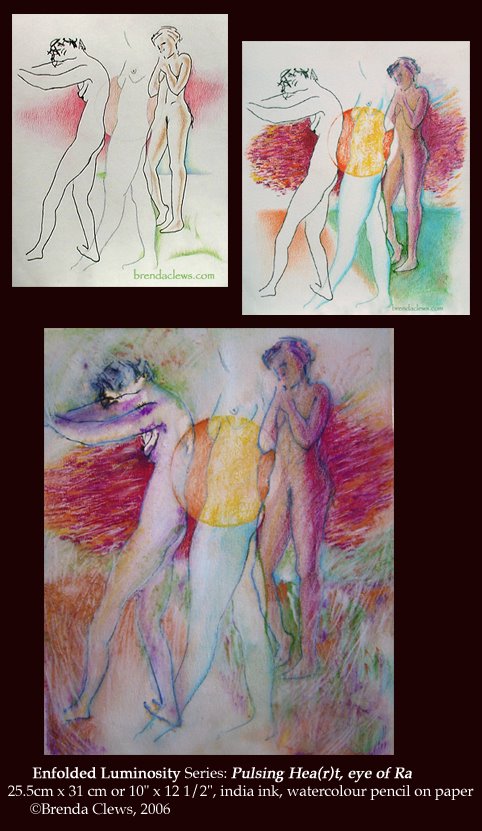
Enfolded Luminosity: Pulsing Hea(r)t, eye of Ra
%903 %UTC, %2006, %0:%Jan %ZA reading, a response, an interweaving, a myth-making story of the artwork by a young woman who goes by the blog name of BoureeMusique. If anyone else has a reading, I'll post it too. Many thanks!
 (click on image to enlarge)
How many times can a woman post an image? It's renamed, from "Willow Women," to, "Pulsing Hea(r)t, eye of Ra." I would read that, pulsing heat/heart, eye of Ra. Why? They clearly don't look like willow women anymore- they were so stretched I thought of them as mirages, as desert dwellers (in the surreal mind it doesn't matter if willows and deserts don't go together). But that pulsing sunset, the way it throbs through them, the desert, Egypt, the Nile, Ra, ah! But Hathor, the queen who wears the sun with two horns- and who is most likely the more ancient goddess of light (before Ra, who came before Horus). It's all bound in up there. I wonder what myth the figures in this painted drawing belong to? I wonder if I can make one up, or if you can?
 (click on image to enlarge)
~~~
I will play with it - from left to right, they can be Gwynhwyfar, Morgaine, and Igraine. The Goddess surrounds and envelops them, is the vibrant sun and blood color. Gwynhwyfar is on the left, half-recognizing the Goddess's call but running from it. All she wants is the true love of a man she should have had. Had her marriage been different, life would be less painful for all of Camelot. Igraine is on the right, held by the Goddess mostly complacently. She stands motionless and in a dream-like state, thinking of her Uther. Morgaine is in the middle, her face ethereal because at times she truly embodies the Goddess. She strides - proud but more than that - confident. She sees bitter times, but the sun, the power, is always at her center, because she is ever true. BoureeMusique
I will play with it - from left to right, they can be Gwynhwyfar, Morgaine, and Igraine. The Goddess surrounds and envelops them, is the vibrant sun and blood color. Gwynhwyfar is on the left, half-recognizing the Goddess's call but running from it. All she wants is the true love of a man she should have had. Had her marriage been different, life would be less painful for all of Camelot. Igraine is on the right, held by the Goddess mostly complacently. She stands motionless and in a dream-like state, thinking of her Uther. Morgaine is in the middle, her face ethereal because at times she truly embodies the Goddess. She strides - proud but more than that - confident. She sees bitter times, but the sun, the power, is always at her center, because she is ever true. BoureeMusique
Comments (4)
My small library...
%602 %UTC, %2006, %0:%Jan %ZI'm far from the world of the text, yet I'm creating my own broken text. Everything spins in my head, fragments of text here, partial images there, authors listed on rolled parchment. Perhaps the texts I've read are smattered over my mindscape like collages: rearranged, cut, reoriented, given different colours, rotated, fragments repeated that have no meaning other than to me. In my private mythology, the place where I make meaning of the heiroglyphic world, where thoughts are scrawled across pages, edited and formatted, lines drifting by that I barely see anymore. I have lost my library. The books I didn't try to memorize on the shelves where they could be found and browsed through. What I underlined then I would still underline today. When did I discover what struck me as most important and relevant could be discerned in a speed read of a few hours and it was the same as what emerged from reading slowly over a week? This discovery enabled me to read vastly and widely through a number of years. The text no longer frightened me with its weight of meaning and the tradition out of which it arose. I could read sources, influences, backgrounds, other authors of the same time period for context. One book opened another. What's important to me remains important to me and didn't change with speed of reading, nor time.
I'm still trying to understand the fundamental grammar of my life. The basic building blocks. What foundation I rest on. In the exegesis of myself, I tear my texts apart until I find bare letters, signs floating over the ground of my being.
Our artifacts are all that will remain of us.
Bare words dragged across the whiteness of pages. A few images here and there. A tune. A tiny bundle of photographs. Some memoraphilia. Memory for a generation or two.
I have been without my small library for half a year and I feel adrift and bereft. How do I re-collect those books, their memories?
Francis Yates. The Art of Memory, on Giordiano Bruno in the Renaissance. Vast tracts, whole books, entire epic poems memorized. A guide to oral memory. How did they do it? By creating a structure to keep books, chapters, paragraphs and lines in. A vast palace of the mind; the inner library. Organized, polished, filed; the cadences of words creating a natural punctuation. And so I must remember my library, for I miss it.
One packed bookcase of art books, from Prehistoric Art to the Present. A shelf of fat, white Abrams art books. Colour images. Hundreds of small colour edition books on individual artists, from the late Medieval period to the 20th Century. Numerous critics, from Ruskin to Greenburg to feminism to the new media.
Two packed bookcases of English Literature. I put Greek literature in here too. Homer, Ovid, Aeschelus. And Babylonian. Gilgamesh; Inanna. And then the periods: Medieval, Renaissance, followed by centuries, 17th, 18th, 19th, 20th. Chaucer, Marlowe, Shakespeare, Donne, Pope, Blake, the Romantics, the Pre-Raphaelites, Morris, Woolf, Proust, Joyce... Modern poetry had its own section, and so did novels, which were filed alphabetically.
One bookcase of Psychology, Sociology, Mythology. This is where Jung & Freud went, and Schzaz, and Neumann and Campbell, a couple of first year Introduction to Psychology texts, not much interest in the field. Along with gentle music that I used for the relaxation sequences of my yoga classes. And underneath were numerous books of photographs.
Then a packed bookcase on Science and Philosophy. I stopped collecting Science books a decade or two back. Philosophy had all the classics, the Greek Philosophers, Plato, Aristotle, jumping to Bacon and then on through to perhaps Existentialism, and into our era. Those massive collection books, like Zimmer's Philosophies of India, and another one on Chinese Philosphy. All read, all duly underlined, notes written in some book somewhere or other. People like Augustine and Aquinas were in religion.
Religion a packed bookcase, everything from so-called primitive religions to Christianity to Shaminism and Witchcraft and New Age. My small collection of the Medieval Christian mystics there.
Women's writing took up 2 bookcases. All of it 20th Century. Novels, poetry, essays, feminist theory. And my own area of speciality, maternal theory, packed a smaller bookcase, along with many drafts towards a book spanning almost 2 decades.
Next to my bed the books I was currently reading, and ones most relevant to whatever my current project was. In Vancouver I remember Alex Grey's paintings on birth, which I wanted to study to understand, and still do.
The chunks of the thought of whole lifetimes of thinkers, writers, artists, books organized in simple categories of knowledge, bits of lines, notations in my head, dim memories of book covers. I see my bookcases packed with books that were all read like disappearing visions of another lifetime.
And I wonder if I will ever be re-united with them, these old friends of mine, companions of many years, in the days to come. And I wonder what will happen to me if I never again see them, touch them, open and read the chapter headings, my underlined sections, run my fingers over their spines as I dust them.
Will only fragments of text remain, floating in my mind like resurrected debris torn from its context, its pages, the beautiful books I collected for so many years?
What is to happen now?
I'm still trying to understand the fundamental grammar of my life. The basic building blocks. What foundation I rest on. In the exegesis of myself, I tear my texts apart until I find bare letters, signs floating over the ground of my being.
Our artifacts are all that will remain of us.
Bare words dragged across the whiteness of pages. A few images here and there. A tune. A tiny bundle of photographs. Some memoraphilia. Memory for a generation or two.
I have been without my small library for half a year and I feel adrift and bereft. How do I re-collect those books, their memories?
Francis Yates. The Art of Memory, on Giordiano Bruno in the Renaissance. Vast tracts, whole books, entire epic poems memorized. A guide to oral memory. How did they do it? By creating a structure to keep books, chapters, paragraphs and lines in. A vast palace of the mind; the inner library. Organized, polished, filed; the cadences of words creating a natural punctuation. And so I must remember my library, for I miss it.
One packed bookcase of art books, from Prehistoric Art to the Present. A shelf of fat, white Abrams art books. Colour images. Hundreds of small colour edition books on individual artists, from the late Medieval period to the 20th Century. Numerous critics, from Ruskin to Greenburg to feminism to the new media.
Two packed bookcases of English Literature. I put Greek literature in here too. Homer, Ovid, Aeschelus. And Babylonian. Gilgamesh; Inanna. And then the periods: Medieval, Renaissance, followed by centuries, 17th, 18th, 19th, 20th. Chaucer, Marlowe, Shakespeare, Donne, Pope, Blake, the Romantics, the Pre-Raphaelites, Morris, Woolf, Proust, Joyce... Modern poetry had its own section, and so did novels, which were filed alphabetically.
One bookcase of Psychology, Sociology, Mythology. This is where Jung & Freud went, and Schzaz, and Neumann and Campbell, a couple of first year Introduction to Psychology texts, not much interest in the field. Along with gentle music that I used for the relaxation sequences of my yoga classes. And underneath were numerous books of photographs.
Then a packed bookcase on Science and Philosophy. I stopped collecting Science books a decade or two back. Philosophy had all the classics, the Greek Philosophers, Plato, Aristotle, jumping to Bacon and then on through to perhaps Existentialism, and into our era. Those massive collection books, like Zimmer's Philosophies of India, and another one on Chinese Philosphy. All read, all duly underlined, notes written in some book somewhere or other. People like Augustine and Aquinas were in religion.
Religion a packed bookcase, everything from so-called primitive religions to Christianity to Shaminism and Witchcraft and New Age. My small collection of the Medieval Christian mystics there.
Women's writing took up 2 bookcases. All of it 20th Century. Novels, poetry, essays, feminist theory. And my own area of speciality, maternal theory, packed a smaller bookcase, along with many drafts towards a book spanning almost 2 decades.
Next to my bed the books I was currently reading, and ones most relevant to whatever my current project was. In Vancouver I remember Alex Grey's paintings on birth, which I wanted to study to understand, and still do.
The chunks of the thought of whole lifetimes of thinkers, writers, artists, books organized in simple categories of knowledge, bits of lines, notations in my head, dim memories of book covers. I see my bookcases packed with books that were all read like disappearing visions of another lifetime.
And I wonder if I will ever be re-united with them, these old friends of mine, companions of many years, in the days to come. And I wonder what will happen to me if I never again see them, touch them, open and read the chapter headings, my underlined sections, run my fingers over their spines as I dust them.
Will only fragments of text remain, floating in my mind like resurrected debris torn from its context, its pages, the beautiful books I collected for so many years?
What is to happen now?
Comments (8)
On diets, from a letter to a friend...
%536 %UTC, %2006, %0:%Jan %Z Posted this, took it down, and received a beautiful comment from Ken, who couldn't find the post, so it's back... and then added a bathroom-mirror self-portrait, which I'm sure I'll feel silly about after I've gone out dancing, & want to come home & take it down, but which somehow seems part of a post on diet.
~
I like some weight on a man. They're always so self conscious about it too. It's quite funny. Perhaps I don't find that lean and mean in a man who's heavier? They're not happy with their bodies and want you to see pics of them when they were 'in shape,' but just as they like eating, they like sex. A man with a girth is more sensual, there's no doubt about it. In my experience anyhow. And maybe softer inside too, which I really adore.
How I would apply all that to myself I don't know. I've lost about 10 lbs since moving, but it's mostly due to lack of work, income, settledness, even kitchen supplies. I love food, tastes, textures, colours. But dislike being overly full. And wheat gives me heartburn, so I stay away from breads. Well, most carbs. They're just too heavy for me, give me indigestion. So lots of vegetables, dairy, meat, chocolate, and a slice or so of 12 grain bread a day. Like a yogi, I rarely eat after 6pm at night. I dunno. In my early 20s I was severely bulimic. It was quite a journey out of it. But I did it, on my own, it was my 'secret,' and found after I stopped binging and throwing up that my weight remained the same. I didn't put on any weight at all. Part of the journey out of bulimia was discovering that I don't need 3 meals a day, 2 is enough, and that wheat really makes me feel quite sick, and was often the reason I threw up I guess. Mind you, I still love a fresh white flour poppy seed bagel slathered in butter, but I know I'll pay for it with acid reflux some hours afterwards. My treats, then, aren't pastries, sigh, but chocolate things, coconut is ok too. All of which keeps my weight down. Since breads, starchy foods are real weight putter oners. Diet has been a long process for me. And I see my 15 year old daughter going through it now- and is trying to limit foods like pancakes, donuts, bread since she does see a direct correlation to her weight. I mean, we find that pigging out on a half a dozen buttertarts doesn't put weight on the way half a dozen donuts do. It's so interesting the way the body metabolizes, or doesn't metabolize, foods. Some foods just get converted into and stored as fat cells, I guess. Or that's how it seems. There's no reason why indulging in a large bar of imported chocolate shouldn't put on weight like a box of Krispy Kreme donuts, but it doesn't. I've always wondered if it's got something to do with evolution, and that we're optimally healthy on a 'pre-farming' diet... that wheat, corn, rice, all the cultivated crops, while feeding us in multitude, aren't really suited to our digestive systems. Evolution takes a lot longer to catch up, perhaps. I seem to do very well on what I would consider to be a modern version of the hunting-&-gathering diet. Don't laugh, and please laugh. When I talk like this people usually studiously ignore me as a crackpot.
Comments (12)
Sep 2026
Jul 2026
Apr 2025
Feb 2025
Jun 2024
Apr 2024
Aug 2023
Oct 2022
May 2022
Oct 2021
Sep 2021
Jul 2021
May 2021
Jan 2021
Oct 2020
Aug 2020
Jul 2020
Jun 2020
May 2020
Dec 2019
Sep 2019
Aug 2019
Jul 2019
May 2019
Apr 2019
Feb 2019
Jan 2019
Nov 2018
Sep 2018
Aug 2018
Jul 2018
May 2018
Apr 2018
Mar 2018
Feb 2018
Jan 2018
Dec 2017
Nov 2017
Oct 2017
Sep 2017
Aug 2017
Jul 2017
Jun 2017
May 2017
Apr 2017
Mar 2017
Feb 2017
Jan 2017
Dec 2016
Nov 2016
Oct 2016
Sep 2016
Aug 2016
Jul 2016
Jun 2016
May 2016
Apr 2016
Mar 2016
Feb 2016
Jan 2016
Dec 2015
Nov 2015
Oct 2015
Sep 2015
Aug 2015
Jul 2015
Jun 2015
May 2015
Apr 2015
Mar 2015
Feb 2015
Jan 2015
Dec 2014
Nov 2014
Oct 2014
Sep 2014
Aug 2014
Jul 2014
Jun 2014
May 2014
Apr 2014
Mar 2014
Feb 2014
Jan 2014
Dec 2013
Nov 2013
Oct 2013
Sep 2013
Aug 2013
Jul 2013
Jun 2013
May 2013
Apr 2013
Mar 2013
Feb 2013
Jan 2013
Dec 2012
Nov 2012
Oct 2012
Sep 2012
Aug 2012
Jul 2012
Jun 2012
May 2012
Apr 2012
Mar 2012
Feb 2012
Jan 2012
Dec 2011
Nov 2011
Oct 2011
Sep 2011
Aug 2011
Jul 2011
Jun 2011
May 2011
Apr 2011
Mar 2011
Feb 2011
Jan 2011
Dec 2010
Nov 2010
Oct 2010
Sep 2010
Aug 2010
Jul 2010
Jun 2010
May 2010
Apr 2010
Mar 2010
Feb 2010
Jan 2010
Dec 2009
Nov 2009
Oct 2009
Sep 2009
Aug 2009
Jul 2009
Jun 2009
May 2009
Apr 2009
Mar 2009
Feb 2009
Jan 2009
Dec 2008
Nov 2008
Oct 2008
Sep 2008
Aug 2008
Jul 2008
Jun 2008
May 2008
Apr 2008
Mar 2008
Feb 2008
Jan 2008
Dec 2007
Nov 2007
Oct 2007
Sep 2007
Aug 2007
Jul 2007
Jun 2007
May 2007
Apr 2007
Mar 2007
Feb 2007
Jan 2007
Dec 2006
Nov 2006
Oct 2006
Sep 2006
Aug 2006
Jul 2006
Jun 2006
May 2006
Apr 2006
Mar 2006
Feb 2006
Jan 2006
Dec 2005
Nov 2005
Oct 2005
Sep 2005
Aug 2005
Jul 2005
Jun 2005
May 2005
Apr 2005
Mar 2005
Feb 2005
Jan 2005
Sep 2004
Jun 2004
May 2004
Oct 2003
Jul 2026
Apr 2025
Feb 2025
Jun 2024
Apr 2024
Aug 2023
Oct 2022
May 2022
Oct 2021
Sep 2021
Jul 2021
May 2021
Jan 2021
Oct 2020
Aug 2020
Jul 2020
Jun 2020
May 2020
Dec 2019
Sep 2019
Aug 2019
Jul 2019
May 2019
Apr 2019
Feb 2019
Jan 2019
Nov 2018
Sep 2018
Aug 2018
Jul 2018
May 2018
Apr 2018
Mar 2018
Feb 2018
Jan 2018
Dec 2017
Nov 2017
Oct 2017
Sep 2017
Aug 2017
Jul 2017
Jun 2017
May 2017
Apr 2017
Mar 2017
Feb 2017
Jan 2017
Dec 2016
Nov 2016
Oct 2016
Sep 2016
Aug 2016
Jul 2016
Jun 2016
May 2016
Apr 2016
Mar 2016
Feb 2016
Jan 2016
Dec 2015
Nov 2015
Oct 2015
Sep 2015
Aug 2015
Jul 2015
Jun 2015
May 2015
Apr 2015
Mar 2015
Feb 2015
Jan 2015
Dec 2014
Nov 2014
Oct 2014
Sep 2014
Aug 2014
Jul 2014
Jun 2014
May 2014
Apr 2014
Mar 2014
Feb 2014
Jan 2014
Dec 2013
Nov 2013
Oct 2013
Sep 2013
Aug 2013
Jul 2013
Jun 2013
May 2013
Apr 2013
Mar 2013
Feb 2013
Jan 2013
Dec 2012
Nov 2012
Oct 2012
Sep 2012
Aug 2012
Jul 2012
Jun 2012
May 2012
Apr 2012
Mar 2012
Feb 2012
Jan 2012
Dec 2011
Nov 2011
Oct 2011
Sep 2011
Aug 2011
Jul 2011
Jun 2011
May 2011
Apr 2011
Mar 2011
Feb 2011
Jan 2011
Dec 2010
Nov 2010
Oct 2010
Sep 2010
Aug 2010
Jul 2010
Jun 2010
May 2010
Apr 2010
Mar 2010
Feb 2010
Jan 2010
Dec 2009
Nov 2009
Oct 2009
Sep 2009
Aug 2009
Jul 2009
Jun 2009
May 2009
Apr 2009
Mar 2009
Feb 2009
Jan 2009
Dec 2008
Nov 2008
Oct 2008
Sep 2008
Aug 2008
Jul 2008
Jun 2008
May 2008
Apr 2008
Mar 2008
Feb 2008
Jan 2008
Dec 2007
Nov 2007
Oct 2007
Sep 2007
Aug 2007
Jul 2007
Jun 2007
May 2007
Apr 2007
Mar 2007
Feb 2007
Jan 2007
Dec 2006
Nov 2006
Oct 2006
Sep 2006
Aug 2006
Jul 2006
Jun 2006
May 2006
Apr 2006
Mar 2006
Feb 2006
Jan 2006
Dec 2005
Nov 2005
Oct 2005
Sep 2005
Aug 2005
Jul 2005
Jun 2005
May 2005
Apr 2005
Mar 2005
Feb 2005
Jan 2005
Sep 2004
Jun 2004
May 2004
Oct 2003